Australian intelligent navigation systems company Advanced Navigation says funds from a A$158 million (US$112 million) series C equity financing will go towards accelerating development of its unique underground mine vehicle guidance sensors and software.
Airtree Ventures, Quadrant Private Equity and Australia’s National Reconstruction Fund Corporation (NRFC) have backed Sydney-based Advanced Navigation’s latest raise, said to have confirmed its A$1 billion enterprise valuation. The company, founded in 2012, has raised more than US$200 million since 2019.
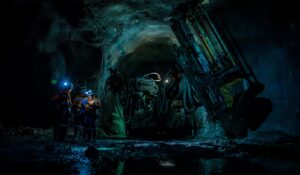
It engaged BHP and Finland’s Normet in a trial last year at the 1.4km-deep Callio mine at Pyhajarvi in central Finland to successfully validate the accuracy and robustness of its navigation system in a GNSS-denied environment. The former base metals mine is now used as a test centre for new technology.
Advanced Navigation’s technology is also said to be used by NASA, Boeing, Tesla, Anduril, Hanwha and Intuitive Machines among more than 2800 customers with the US and Europe accounting for over 80% of its circa-US$50 million 2025 revenues.
“Advanced Navigation has built the leading solution in the positioning field and their rapid expansion into the US and Europe marks a definitive shift for mission-critical industries as global demand converges around the precise use case they solve,” Airtree Ventures partner Kelland Reilly said.
NRFC, which invested more than $35 million in Advanced Navigation, believes the company can also help build Australia’s “sovereign and defensive capabilities” and future navigational tools. “NRFC investment in Advanced Navigation will keep the company’s headquarters, core R&D and high-precision manufacturing capabilities here in Australia,” CEO David Gall said.
Advanced Navigation co-founder and CEO Chris Shaw said the company was looking to significantly scale its deep-tech operational and engineering presence in key markets. It expected to double its current c250 workforce in the next 12-to-18 months.
“As autonomous vehicles scale into contested and high-stakes frontiers the world’s reliance on any single navigation technology has evolved from a technical limitation into a systemic vulnerability,” Shaw said.
“To power the next generation of autonomous systems, Advanced Navigation is combining deep learning software with high-precision hardware to help systems conquer the extremes across sea, land, air and space.
“The era of relying on a single silver bullet for navigation is over. The future belongs to intelligent systems that can sense, adapt and navigate independently. We are building the resilient foundation by fusing high-precision inertial hardware with onboard intelligence, ensuring autonomous systems behave predictably in unpredictable environments.”
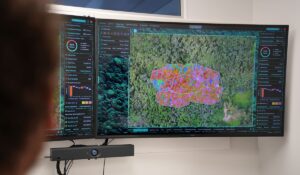
Advanced Navigation launched its Chimera Land 3D laser velocity sensor earlier this year after it was used in the Finland deep mine test. The company said when integrated with its proprietary AdNav Intelligence software and Boreas onboard inertial navigation system, Chimera Land enabled underground vehicles to maintain stable navigation over extended distances and time.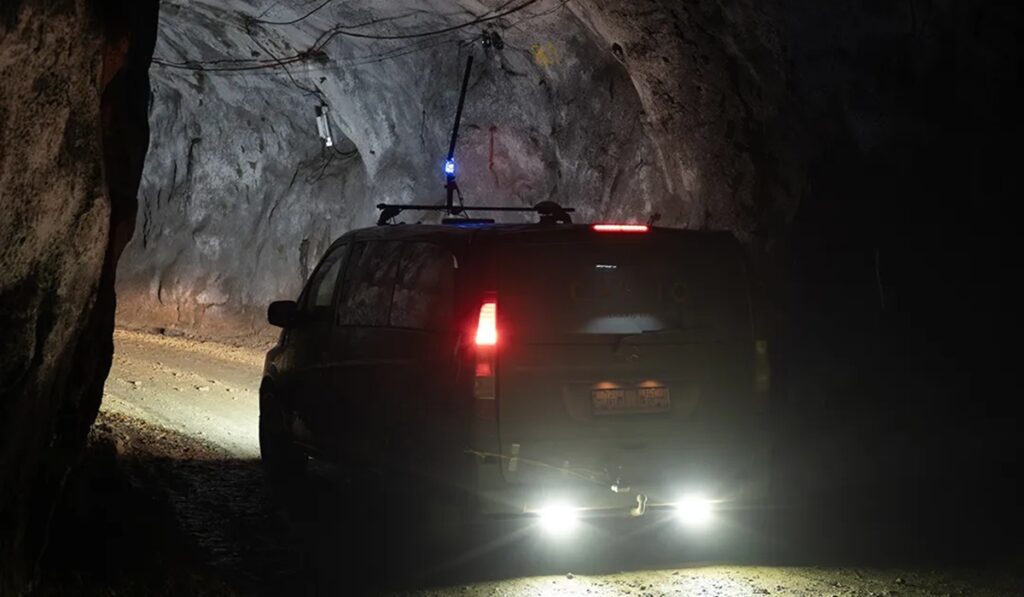
Advanced Navigation describes Boreas INS, said to be materially lighter, smaller and cheaper than other available tech, as the “future of fibre-optic gyroscopes”.
“Instead of needing to ask an external beacon or satellite for its location the sensor uses specialised lasers to measure a vehicle’s ground-relative 3D velocity, with unprecedented accuracy,” the company said.
“By feeding this precise data into the vehicle’s inertial navigation system, the sensor eliminates the inherent drift that typically comes with standalone INS.
“Drawing on adaptive algorithms the [AdNav Intelligence] fusion engine dynamically weights the input from each sensor, adjusting reliance in real time based on their reliability scores, environmental conditions and operational context.”
Advanced Navigation said the BHP trial showed Chimera Land actively reduced the test vehicle’s drift rate to 0.07% – 15.98m over 22.92km – over five separate runs to 1400m below surface. At about 400m depth the dead-reckoning performance was 0.009%: 0.55m over 6km distance travelled.
Barrenjoey was Advanced Navigation’s financial adviser on the series C round, which reportedly could grow to US$213 million with secondary share sales over the next month.