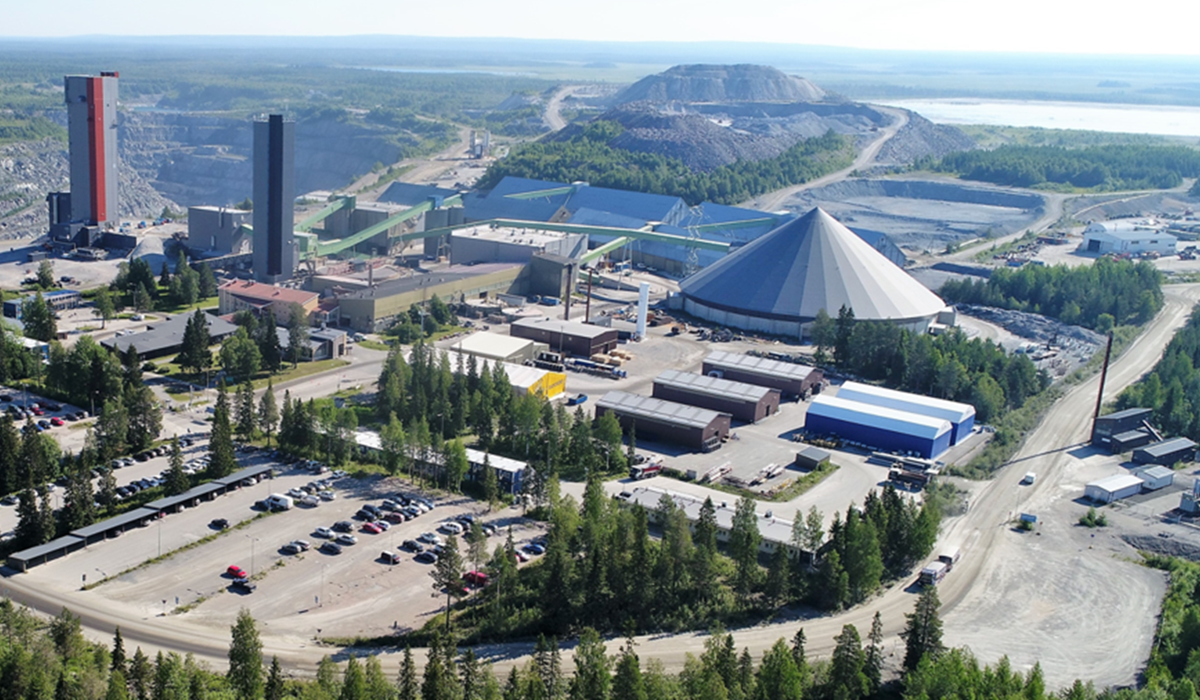
Finland steel producer Outokumpu will provide comprehensive data on about three million tonnes of waste and tailings material being produced annually at its Kemi chrome mine in a bid to draw commercial partners into a “circular economy ecosystem” that can be replicated elsewhere.
The €2.2 billion Helsinki-listed and headquartered company will invite potential partners into the project next month.
It will provide “transparent” mining data on the quantity, quality, and suitability of various side streams for potential new partners.
“The project is based on strategic cooperation with the Geological Survey of Finland and VTT Technical Research Centre of Finland, forming the scientific, technological and international foundation of the ecosystem,” Outokumpu said.
Kemi, Europe’s only chrome operation, started life in 1968 as a surface mine and now produces solely from underground. Chromite ore is concentrated on site and transported to the group’s ferrochrome smelter in Tornio, where it also has a stainless steel mill.
Outokumpu said some waste was being used in the mining area and outside of it. Much more could be deployed in future to improve soils, as a low-carbon cement replacement, in carbon sequestration and thermal energy storage, sand batteries and mineral recovery.
“The EU’s green transition increases the need for new kinds of solutions, especially as the need for critical raw materials and material efficiency requirements are rapidly changing the operating environment,” said Outokumpu ferrochrome business area president, Martti Sassi.
“The utilisation of side streams is no longer just an environmental act, but part of competitiveness and supply security.
“Our Kemi mine is the only chromium mine in the EU and plays a strategic role in ensuring critical mineral self-sufficiency as well as the entire stable and low-emission value chain. The project now launched at the mine is part of Outokumpu’s wider ecosystem in Kemi-Tornio, the future potential of which we see as significant.
“Our business is strongly based on the circular economy, as more than 95% of the raw materials we use are already recycled.”
The Regional Council of Lapland is backing the project through the EU-funded Lapland Mining Hub. Hub project manager Ida Paaso said European Regional Development Fund (ERDF) support made it essential repeatable circular opportunities were identified.
“We want to create a functional and permanent mining industry ecosystem in the Lapland region, where mine side streams are systematically utilised and where we are known as a pioneer in responsible mining and the circular economy also outside Finland’s borders,” she said.
Sassi said the aim was to build a long-term model around side streams that could be used on an industrial scale, creating new business in both the Lapland region and internationally. No similar model had been developed or implemented in Finland.
“The goal is a long-term collaboration model in which mining, SMEs, research and public sectors work together,” Outokumpu said.