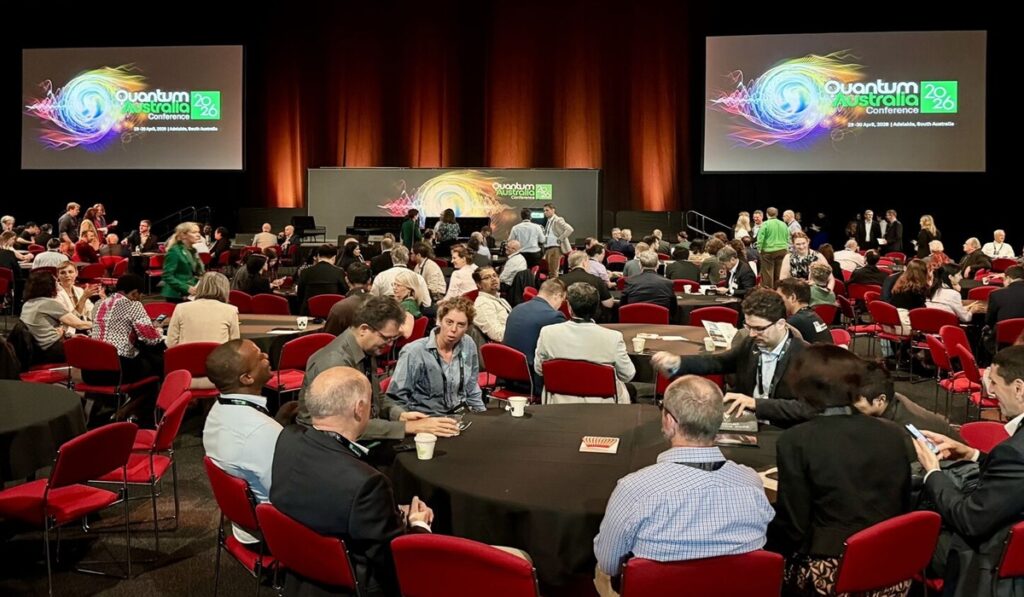
Fortescue independent director Dr Larry Marshall says building companies around quantum technologies is “a bit like trying to bell Schrodinger’s cat”, but that’s not stopping a clowder of mining-tech start-ups from pursuing early opportunities in a market expected to grow exponentially over the next decade.
Marshall, chairing a quantum technology venture capital discussion at the Quantum Australia 2026 conference in Adelaide, South Australia, says it’s a fascinating time to be talking about funding as quantum computing moves from invention to innovation – “often the hardest part of deep tech”.
“How do you build — and fund — companies around technologies that don’t fully exist yet, for markets that aren’t fully formed?” Marshall asked, evoking a certain Austrian physicist’s famous moggy, in the lead up to QA2026. “That’s exactly what today’s quantum founders and investors are navigating.
“This year’s Quantum Australia conference is focused on how quantum is already delivering real productivity gains and commercial outcomes across sectors like energy, defence, health and mining, not just future promise.”
The sixth Quantum Australia conference from April 28-30 being run by Australia’s national centre heard the country’s “quantum ecosystem” features more than 40 quantum-focused companies and a broader network of connected businesses and researchers. Quantum Australia CEO Petra Andren said quantum technology and mining could be a particularly compelling combination in Australia. “Australia has both the geological advantage and the technical capability but capturing that opportunity will depend on how quickly industry moves from exploration to deployment and how effectively research, industry and government are aligned to support that transition,” she said.
Conference speakers, including BHP Ventures portfolio strategy head Melissa Bergin and CEO of Adelaide-based Fleet Space Technologies, Flavia Tata Nardini, highlighted new and emerging quantum technology use cases in mineral exploration, surveying, modelling, mining and hazard mitigation. Bergin says Australia “has a real opportunity to lead in quantum technologies”.
The mining major’s venture arm has taken equity stakes in mining quantum sensor firms such as Atomionics, which raised about US$12.7 million last year to scale use of its Gravio quantum gravimetry sensors in subsurface mineral mapping.
BHP is also a user of Fleet Space’s ExoSphere AI-powered mineral exploration platform. Announcing partnerships with Nomad Atomics, DeteQt and mDetect last year, Fleet Space’s Tata Nardini said a “new landscape of Australian-led advanced technology partnerships” could build valuable sovereign supply chain capabilities as they took mineral exploration into the 21st century.
“For the global mining industry to achieve its potential as an industry leader in exploration data-intelligence we must build the deep technologies and infrastructure that integrate breakthrough sensing modalities into a unified system,” she said.
“With our ExoSphere platform Fleet Space has created the next-generation of satellite-connected geophysical methods while also investing in the development of frontier technologies like quantum gravimetry and muon tomography to enhance the predictive power of AI in exploration on a planetary scale.
“Pursuing this mission is critical so humanity doesn’t have to accept trade-offs between technological innovation, clean energy and venturing deeper into our solar system.”
Another Adelaide-based company, Teraglo, recently received a A$2.4 million grant from the Australian Government to advance its quantum artificial intelligence material sensing (QAIMS) portable sensors. Speaking at QA2026, Teraglo CEO Aaron Baensch emphasised the role of quantum sensing technologies in subsurface mapping and mineral detection, including efforts to integrate them into real-world exploration workflows to support more accurate and efficient resource discovery.
Baensch said the Critical Technologies Challenge Program government grant, specifically for developing a quantum-enabled, in-field geometallurgy sensor for clay-hosted rare earths, was funding Teraglo’s work with Australian Rare Earths, ABx Group and Adelaide University’s Institute for Photonics and Advanced Sensing.
“This project represents a shift in how we approach mineral exploration and processing,” Baensch said.
“By bringing quantum-enabled precision directly into the field we aim to eliminate the traditional delays of lab-based assays, providing real-time data where it matters most.”