Canada’s Teachers’ Venture Growth has led a A$150 million (US$100 million) funding round for Australian sub-surface exploration technology firm, Fleet Space Technologies, which says it is one of the few companies globally to close a Series D financing in this year’s subdued venture capital market.
TVG is part of the Ontario Teachers’ Pension Plan Board, said to have net assets of more than C$250 billion in the middle of this year.
Existing Fleet Space investors Blackbird Ventures, Hostplus, Horizons Ventures, Artesian Venture Partners and Alumni Ventures also participated in the latest equity funding round, which gave the Adelaide-based company a circa-A$800 million valuation, it said.
Fleet Space raised A$50 million at a $350 million valuation a year ago.
“Current mineral exploration methods are inadequate for efficient discovery and production. Fleet Space addresses this with advanced 3D subsurface imaging and AI analysis tools, which have the potential to sustainably transform the industry,” said TVG managing director Rick Prostko.
“We are proud to support the multidisciplinary team at Fleet Space in their efforts to accelerate the global energy transition.”
Fleet Space has developed and commercialised nanosatellite-linked, lightweight terrestrial geophysical survey tools and proprietary multimodal AI models said to be used by more than 40 mineral explorers including mining industry majors such as Rio Tinto and Barrick.
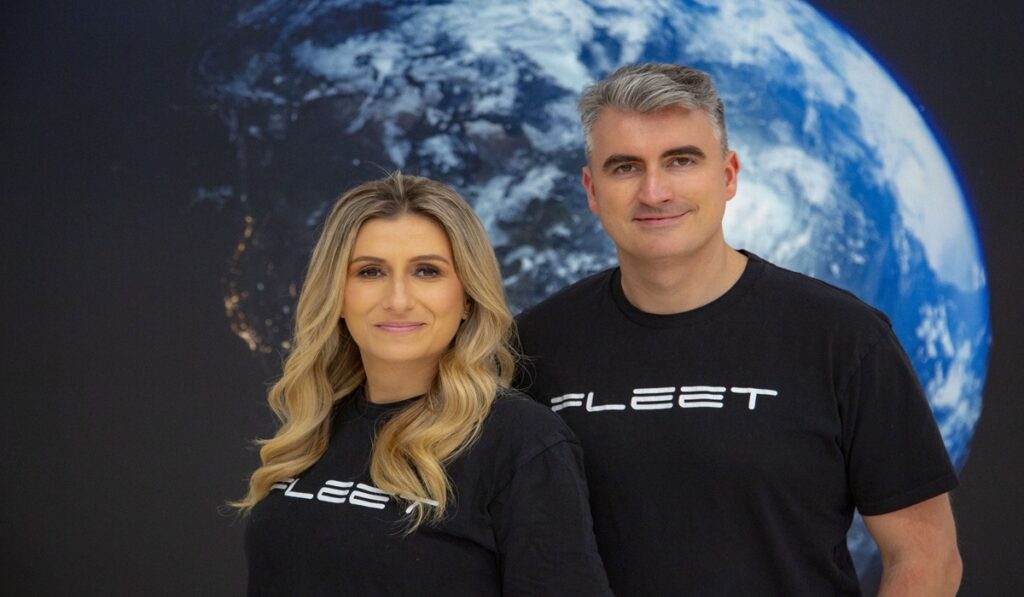
Co-founder and CEO Flavia Tata Nardini, a former propulsion engineer at the European Space Agency, said integrating the company’s low Earth orbit (LEO) satellites, smart seismic sensors and AI streamlined exploration data acquisition and processing to help speed high-quality targeting while minimising environmental impact.
“There are two versions of the future,” said Tata Nardini.
“One where we bend the latest advances in space, AI, and big data towards building a clean energy future and another where we risk net-zero targets falling out of reach as the rate of new discoveries of energy transition minerals continues to decline.
“With ExoSphere we have combined these technologies into an end-to-end platform that seamlessly integrates with and complements modern mining operations, making the frontier of exploration technology accessible to the global mining industry within a single workflow.”
Fleet Space says its terrestrial ExoSphere system is the technological precursor for a lunar variant, Seismic Payload for Interplanetary Discovery, Exploration and Research (SPIDER) which will be deployed on the Moon in 2026.
“Collaborating with MIT Media Lab’s Space Exploration Initiative, Fleet Space is also helping to advance off-world research needed for the planning of future missions to the Moon, Mars and beyond,” the company says.
“Fleet Space [has also] unveiled a cost-effective, resilient full duplex SATCOM system using microsatellites and reprogrammed Centauri-4 to become the world’s smallest voice-enabled satellite.”
Fleet Space says it now has more than 130 employees in Australia, US, Canada, Chile and Luxembourg.