Caterpillar will continue to invest heavily in “technology and digital activities” through to 2030 as it seeks to nearly triple the number of “tech-enabled” company machines in the field by that time, according to chief financial officer Andrew Bonfield.
Speaking at the Barclays 43rd Annual Industrial Select Conference in Florida, USA, Bonfield said the equipment manufacturing giant was increasing investment in automation, connectivity and related technologies by 2.5 times over the next 4-5 years. It recently announced a partnership with Nvidia to bring a “new level of machine intelligence” to Caterpillar mining and construction equipment.
This month it closed its US$736 million acquisition of Australian mining software company RPMGlobal.
“[This] is where a significant amount of our investment dollars are going … through to 2030,” Bonfield said in Miami.
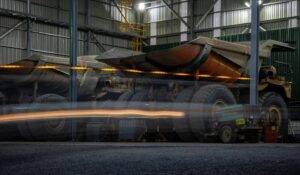
Caterpillar is among a handful of manufacturers that have established a mobile fleet autonomy foothold in mining and quarrying over the past 15 years. It now wants to triple the number of autonomous mining trucks in the field by 2030. “Autonomy and automation are the fastest growing trends in mining with a projected 12% CAGR driven by declining ore grades, rising input costs and certainly continuing labour issues,” Caterpillar Resource Industries president Denise Johnson said at a company investor day last November.
“Caterpillar has moved over seven billion tonnes of dirt autonomously over the years,” Bonfield told the Barclays forum.
“We have over 700 mining trucks out there today operating autonomously.”
Bonfield said an overdue global mining fleet replacement cycle was happening “much slower than people anticipated”, which wasn’t “necessarily a bad thing because what that does mean is you actually see a more steady progression rather than the boom-bust that we have seen in the mining cycle before”.
He said Caterpillar expected to spend about $3.5 billion capex this year as it doubled the capacity of its solar power business and expanded large-engine production by 1.5 times.
“2026 and 2027 will probably be our peak years for capex,” Bonfield said.
“We are doubling capex over the next five years versus the previous five years … but it is still very affordable in terms of our balance sheet and the cash flow generation that we have.”
The projected capex spend would be less than 5% of forecast revenues for the period. Bonfield said Caterpillar had generated more than $9 billion of free cash flow in the past three years, “the highest average free cash flow generation within the S&P 500 industrials [sector] in this period”.