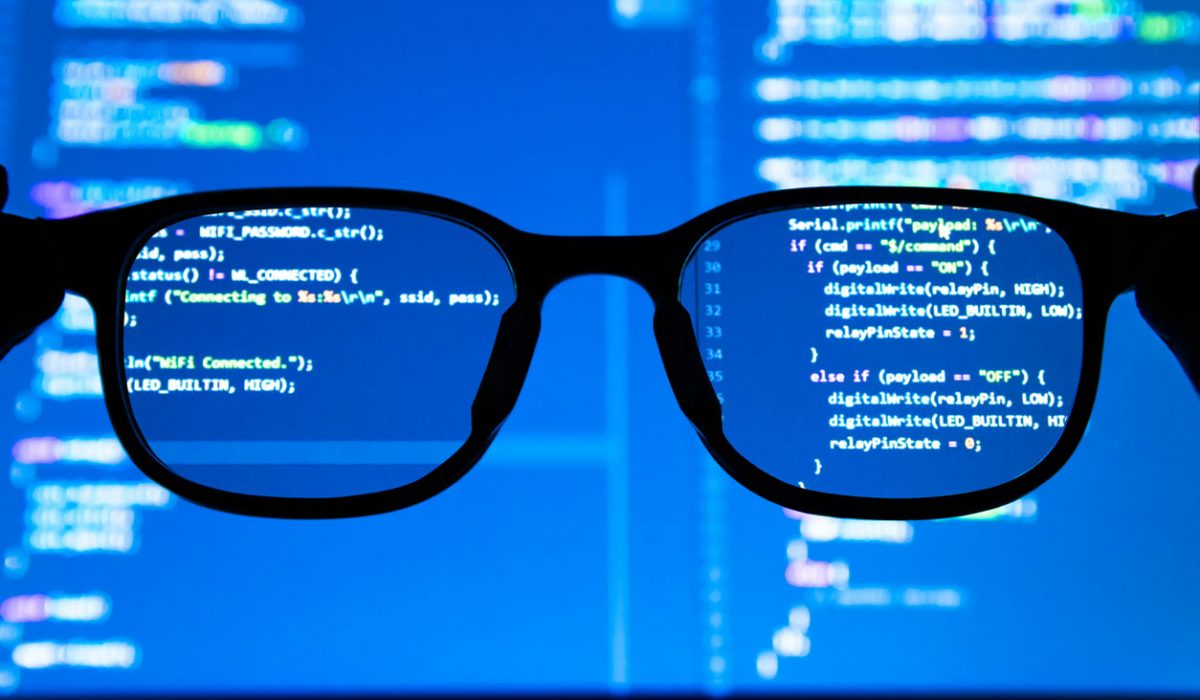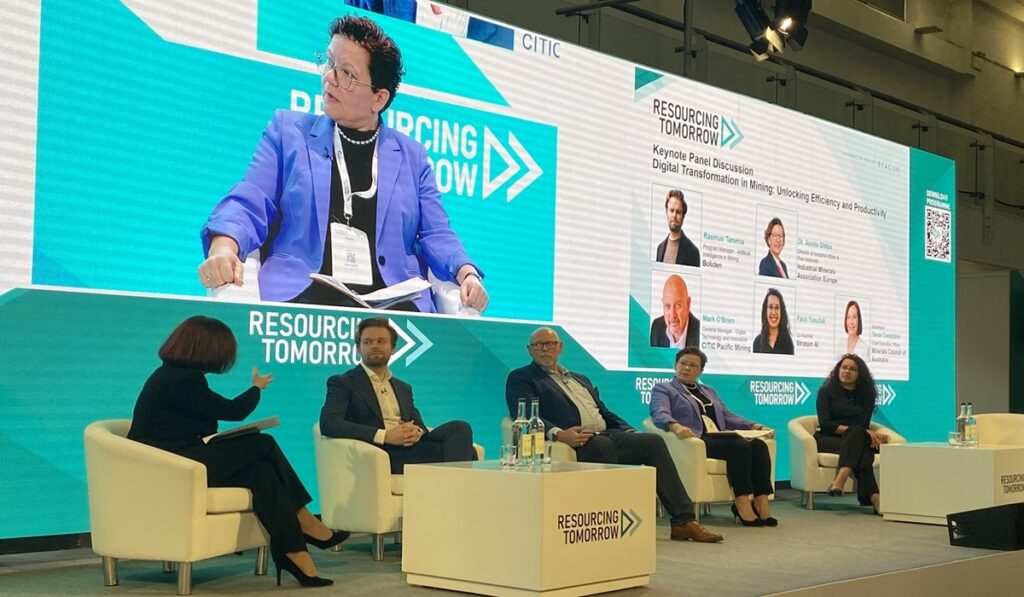
Mining’s artificial intelligence opportunity set is expanding exponentially but it’s not a tool that is going to solve all of the industry’s problems, Resourcing Tomorrow 2025 heard. AI has also opened a cybersecurity Pandora’s Box. “Our OT environments are probably the scariest,” a security expert told the London conference.
Mark O’Brien, general manager for digital technology and innovation at Australian magnetite producer CITIC Pacific Mining, said mine operating environments and the operating technology (OT) in them was often not conceived with continuous software patches in mind.
“A lot of people value things just staying the same and nobody [from outside] messes with anything because it’s working,” O’Brien said at the London conference.
“That’s changing a little bit now as we begin to realise that we’re vulnerable. There have definitely been some celebrated cases of people being breached and seeing operational problems.
“We’ll probably see more of that because at the end of the day as a mining company we have a lot of tool sets, most of them using AI in some form, and the hacker only has to be right once. We have got to be right all the time in terms of the defence.
“The key is to minimise damage and repair it as quickly as possible. But it’s a scary world.”
The view from the other side of the world was not much different. Rasmus Tammia, Swedish metals producer Boliden’s mining AI program manager, said mining OT designed and built to be robust for a decade or more could constrain IT innovation. “That holds us back severely,” he said.
“There’s a reason why these consumer products from Apple, Microsoft and Google have so many incremental updates.
“Whereas we tell our mining vendors and suppliers these [machines and operating systems] are going to have to work for many, many years, which slows down product development.
“I spent almost a year doing risk analysis to be able to deploy cloud native AI solutions to production sites [and the operators were] saying, hey, if you’re going to ruin our production we will kill you, so you better be right.”
O’Brien and Tammia joined the co-founder of Canada’s Stratum AI, Farzi Yusufali, and Industrial Minerals Association Europe director Dr Aurela Shtiza on a Resourcing Tomorrow panel examining digital transformation in mining.
Shtiza said as well as cybersecurity challenges, AI was escalating legal complexity around data-based IP. Who owned the various outputs of data analyses performed on external servers, for example?
“We are in the mining sector: data is power,” she said.
“In artificial intelligence, data is power. At some point we have to ask, who owns the data?”
Yusufali said the industry’s efforts to unlock value from AI-driven data integration and analysis was essentially in its infancy but at the operational level, “most mines already have all the data they need to solve 70% of the problems”.
“It is just being creative about how you combine those datasets.”
O’Brien said: “You can’t go to a conference where AI is not on the agenda in a big way. But the reality is, it’s just a tool and it solves certain kinds of problems really well and other problems maybe not so well.
“But there’s a lot of hype so I think people sort of think it’s the magic bullet for everything.
“I don’t think that’s true. There’s a lot of opportunity, definitely, but I think mining needs to remain pragmatic and focus on solving problems … and there’s this whole area of operations research where a lot of these problems are being solved using fundamental mathematical solutions that are much quicker, much cheaper and probably a better bang for buck in terms of how you solve them.”
Still, O’Brien said, a corner had been turned.
“I think we are in a bit of a transition period,” he said.
“A lot of the young people coming through are definitely [AI] natives.
“When I see a lot of the research papers coming out of mining schools they’re all machine learning papers. These guys are really into the data and they’re going to come into the workforce equipped to really be a lot better and a lot more efficient.
“Which is, I think, a cool thing.”