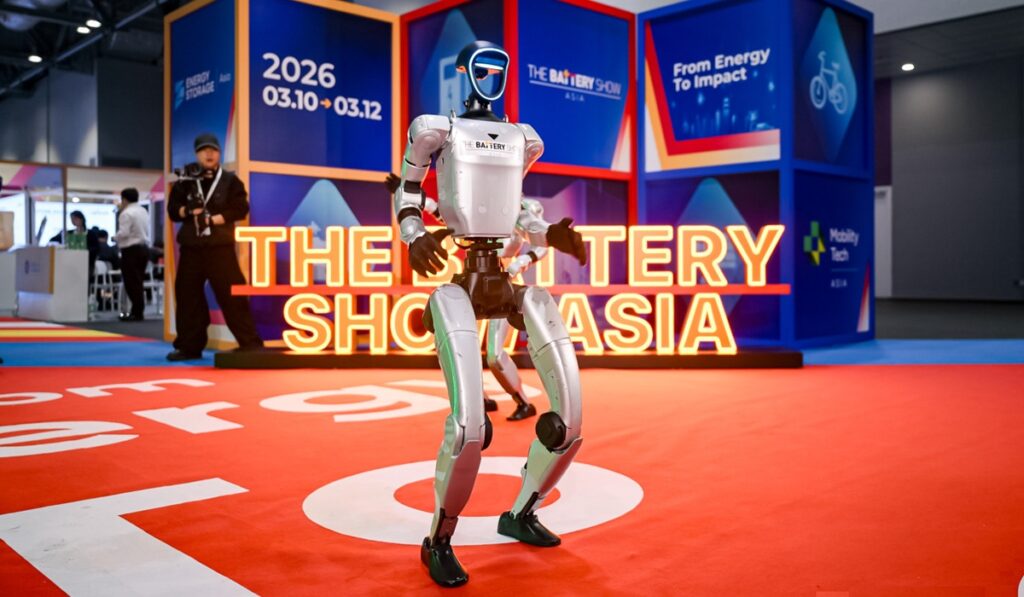
Manganese, titanium and lithium are the “big metal winners” in new battery technology, this month’s Battery Show Asia in Hong Kong heard.
The event, which reportedly featured more than 130 international industry leaders and technical experts on policy trends, markets and new technology, heard a lot about electric vehicle and storage system battery chemistries. According to Red Cloud Securities commodity strategist Ken Hoffman, “all of the talk at the conference” was about a shift in markets towards lithium manganese iron phosphate (LMFP), lithium manganese-rich (LMR), sodium ion and lithium metal anodes.
He said nickel manganese cobalt oxide (NMC) and nickel cobalt aluminium oxide (NCA) chemistries “seem like a dying tech”.
“This is bad news for nickel and especially cobalt as a cathode material,” Hoffman, a speaker at BSA, said.
“Manganese, titanium and lithium are the big metal winners in new battery technology.
“We note BYD’s new version 2.0 Blade technology that promises 1000km range and sub-9-minute recharging times – in some cases sub-3 minutes – uses LMFP batteries. These are known for high energy density, high voltage, great cold weather performance and have lower costs than LFP.”
Hoffman said another key takeaway from his time in Hong Kong, during which he also visited a new drone and robot battery-cell manufacturing facility, was that battery energy storage systems were growing “far faster than anyone thinks”.
“BESS is being driven by the massive increase in AI data farms. Not only do these data farms consume massive amounts of electricity but it is a far different draw of electricity,” Hoffman said.
“Whilst traditional server farms consume a large amount of electricity, it is a stable draw. AI data centres, while being two-t0-10-times bigger than traditional server farms, have an extremely volatile draw of power, which is something grids find hard to control. The solution is to build massive pools of electricity, via a BESS system, to mitigate the AI server farm electricity problem.”
Hoffman cited a senior figure from Chinese battery maker CATL who said BESS sales had gone from zero two years ago to 20% of its business last year. It was projected to exceed 50% by 2028.
“After BESS, its robots and drones,” Hoffman said.
“The rise of AI makes the rapid development of robots and drones possible. These new applications need the latest in battery tech.
“Demand for robot and drone batteries is very large and yet few can make these batteries. The company we visited is growing its cell production for the high-end robot and drone business but even though the Korean government has offered a lot of assistance, including fast tracking, they cannot foresee a time when they, or the industry, can meet demand.
“We note that North American buyers want all equipment and battery materials made outside of China, something few can deliver.
“The bottom line [is that] the battery industry continues to grow at annual rates of between 30-50% and shows no signs of slowing down over the next 5-10 years.”
Morgan Stanley analysts said this week China’s battery-electric vehicle sales fell 11% year-on-year in February, the first yoy monthly fall since March 2024. However, they said the result was likely impacted by the timing of the 2026 Chinese New Year – mid-February versus late January in 2025 – and of the implementation of regional trade-in subsidies.
“China’s broader auto sales, down about 15 yoy, also reflected this,” the bank said.
“We see weakness as timing-related not structural, but [a] March/April recovery will be critical as new models restart the replacement cycle.”
Morgan Stanley said global EV growth could be softer this year – maybe 10% for BEVs and 5% for plug-in hybrid EVs versus 25% and 9% escalation last year.
“Our commodities team sees a circa-80,000 tonnes lithium deficit for 2026,” the bank said.
“For supply, expansions and restarts will likely keep medium-term prices from staying much above incentive levels [but] we see minimal near-term impact from restarts, with Jianxiawo [China] yet to restart but already in our [supply/demand forecasts] and limited other candidates.”
S&P Global earlier this year predicted lithium supply into the grid-scale BESS market could see “mid-double-digit growth in 2026 and continue to be the fastest growing lithium demand source” despite changes to Chinese energy storage mandates that were likely to curtail its recent rapid market expansion.
Lithium major Albemarle’s CEO Kent Masters had forecast lithium demand for stationary storage applications to increase more than 2.5-times by 2030, with North America the fastest-growing region.