Australian mining technology start-up Jevons Robotics sees a significant emerging market for ancillary field robots similar to its ARTEV1000, which has just been snapped up by international mine explosives major, Orica.
“We are proud to take delivery of the first ARTEV1000 in Australia,” Orica Australia Pacific metals vice president Ricky Butler said this week.
“This solution represents one of the many ways we are looking at eliminating manual handling and other on-bench risks for our teams, whilst driving improved safety, productivity and quality for our operations and customers.”
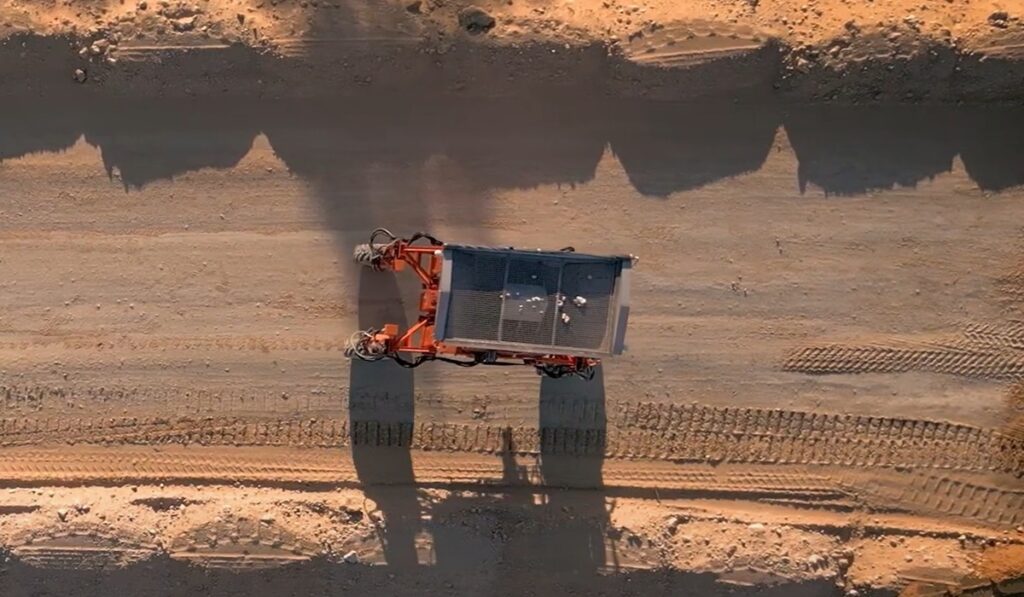
Perth-based Jevons was started by two former Orica executives, Todd Peate and David Crosbie, in 2022. In the past year their first robotic machine, ARTEV6000, remotely loaded production explosives in surface applications without people on the mine bench. The machine also autonomously loaded stemming.
“We believe this to be the first application of autonomous explosives loading in the world,” Peate told InvestMETS.com.
“The hole-finding and deployment capability of the ARTEV1000 is the same as the larger machine; its payload [is smaller]. The 6000 needs to self-level on major contoured areas so needs a complex suspension. The 1000 being smaller is 100% electric, so that allows us to simplify some elements.”
Jevons’ ARTEV6000 is a six-tonne-payload “rover-type” battery-electric vehicle engineered to carry different payloads but built with mine blast-hole loading and stemming in mind. It has the unique self-levelling chassis and a vision system with automated hole-detection capabilities. The unit has effectively navigated 15-degree slopes and 12-degree cross-slopes while maintaining stability for payload deployment.
Peate says the ARTEV1000 brings the same benefits to smaller operations where blasting bench constraints make it “difficult or impossible” to use conventional vehicles.
“This often forces customers to revert to manual handling and deployment, thereby significantly increasing the activity’s risk profile,” he says.
Fewer people can now be involved in 24-7 operations and the ARTEV1000 can also handle multiple payloads. Peate says: “The same machine is now deployed for QAQC automation, stemming and loading ANFO so you remove multiple pieces of equipment and duplicated overheads.
“We see a significant market for this,” he says.
“With different payloads – from geophysical logging tools to stemming to explosives loading – we see hundreds across the world in a decade from now.”
That could include up to 80 units in the next five years in Australia and selected overseas markets.