All votes are finally in for our annual Global Mining Technology Awards and we are excited to announce the winners.
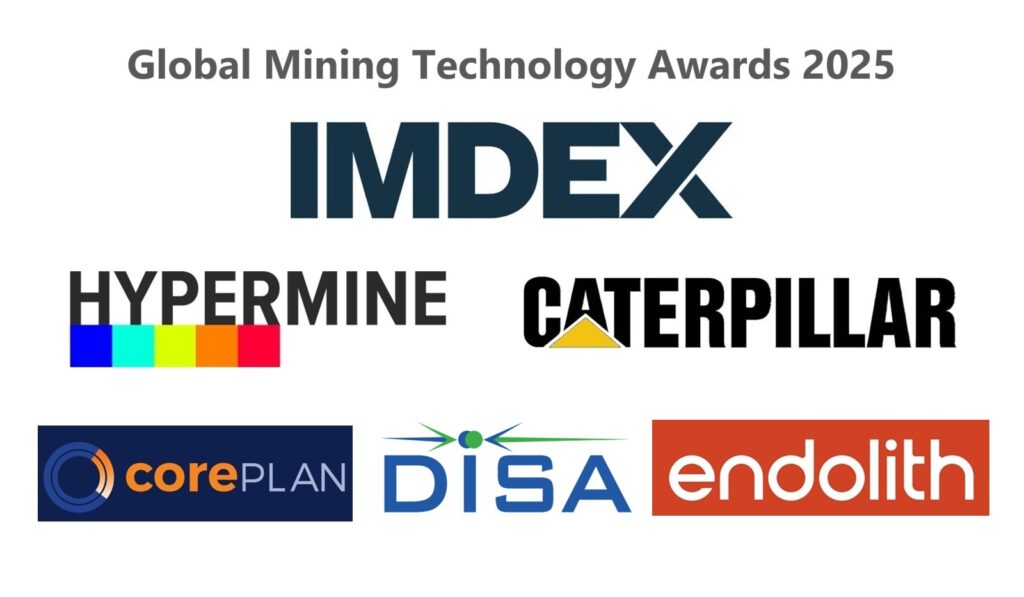
InvestMETS.com congratulates the six recipients of this year’s awards, IMDEX, Endolith, CorePlan, Hypermine, DISA Technologies and Caterpillar. The categories and winners are laid out below.
InvestMETS.com’s anonymous judging process has a mix of miners, market analysts and expert advisers spread across the Americas, Australia-Asia, Europe and Africa. This year we had 30 individuals, including 14 in North and South America – the highest representation from that region so far – and two from southern Africa, the first judges involved from that part of the world.
Judges vote 3-2-1 on the finalists that best meet InvestMETS.com’s category criteria and were put forward during the public nomination period.
IMDEX, which generates about half its annual revenues in the Americas, fared well in voting in the region for this year’s Best Mining Technology Company.
US-based Endolith, which has been recognised in Australia and other parts of the world as an outstanding start-up, won this year’s Best Start-up.
Best start-up
 US-based Endolith was “defining a new class of industrial biotech”, a principal of new investor Squadra Ventures said when the Maryland defence-tech fund got behind a US$13.5 million equity raise by two-year-old Endolith late in 2025.
“By merging biology, data and industrial systems, Endolith is creating a scalable path to critical-mineral security,” Squadra’s Dan Madden said.
Endolith founder and CEO Liz Dennett earlier wowed an audience in Sydney, Australia – where she won a start-up pitch shootout at the IMARC event – with her description of the bio-engineered microbes and AI being used to bring a “biological intelligence layer” to mining. The geomicrobiology and astrobiology PhD said Endolith’s microbes, cloud-native platform and AI-driven intelligence made “a Venn diagram that could really only exist in 2025”.
“Mining has always been grounded in geology, chemistry, physics and engineering,” Dennett says.
“Biology has been there too, quietly operating in the background, shaping mineral systems long before humans learned to blast, crush or leach ore. Microbes have been moving electrons, breaking down pyrite, oxidising iron and sulphur, generating heat and forming small, stable ecosystems inside rock for billions of years.
“The biology is not new. What is new is that we can finally measure it with precision instead of treating it like folklore.
“What is new is our ability to see it.
“Precision biology is the shift. Today, we can screen microbial communities, adapt them to high salinity or arsenic and identify which genes are linked to behaviours like pyrite oxidation. This reaction drives temperature profiles in heaps. We can track pH, ORP, iron, sulphur and copper concentrations in real time. We can match microbial activity to mineralogical changes. When you can finally hear a heap, you can guide it. Once the signals made sense, the heap felt less like a black box and more like a conversation.
“Why does this matter? Because biology helps miners do what they already care about: pull more value from existing ore. Improving recovery on low-grade material, reducing run-of-mine cutoffs from 0.3% to lower thresholds, improving performance in complex mineralogy and making legacy stockpiles productive again all create meaningful economic impact. An 8-to-12% increase in recovery on large operations is not incremental, it is transformative.”
Best scale-up
 CorePlan founder and CEO Alex Goulios told InvestMETS.com after the company recently raised A$5 million of new equity funding the financing and mining-end-user components of the sector’s economic landscape were now starting to evolve rapidly, creating new opportunities and challenges for companies like the one he started in 2016.
“The biggest shift we’re seeing is happening at the decision-maker level,” Goulios said.
“Mining leaders are increasingly focused on compliance, risk reduction and cost control. As teams become more distributed they’re turning to collaboration tools that haven’t traditionally been part of the industry – platforms like Miro, Monday.com, or even AI – and starting to ask why equivalent, purpose-built tools don’t exist for mining. That shift in expectation is fuelling demand. Leaders are now actively seeking technology that reflects how they actually work rather than forcing mining workflows into generic or clunky software.
“And that’s exactly where CorePlan fits in.
“At the same time the way mining teams operate is changing. Work is more cross-functional and distributed and collaboration is now essential. Our user growth is being driven by this move toward more connected, collaborative ways of working across mining operations.
“CorePlan sits in a completely new category for the industry, which is both exciting and challenging. When you’re early in a new space you’re helping shape a new way for the industry to operate. It’s a new way to coordinate drilling and geology operations while integrating smoothly with back-office functions like finance, databases, and compliance – the areas that have traditionally been siloed in mining.
“But that’s also where the opportunity lies. We’ve been able to demonstrate clear ROI for drilling, exploration, and mining teams, reducing admin, speeding up reconciliation and cutting down on errors across operations.”
Western Australia-based CorePlan says its global customer base, including major contractors and miners, spans Asia Pacific, North America, Latin America and Africa. Its cloud-based software is said to support circa-9000 users at more than 600 companies and that is growing at c300 new users a month. The CorePlan platform has been used to manage more than A$6 billion of drilling and mining works, according to the company.
“Our monthly onboarding rate is up at least 80% year-on-year,” Goulios said. “As mining companies digitise they’re deliberately opening access to more users so information flows freely and decisions can happen faster. What’s especially exciting is that most of these users are self-onboarding – a strong sign that teams see clear value and want CorePlan embedded deeper in their day-to-day work.
“The pace of growth really reflects how CorePlan is used. It’s designed as the system of record for drilling programs, which naturally brings multiple teams into the same platform. Once a company adopts CorePlan, finance, geology, engineering, logistics, field teams and contractors all need access to the same source of truth to plan and run drilling programs effectively.
“A big part of our approach is respecting how miners want to manage their data. They want to keep ownership of their data, avoid getting locked into a single vendor and still be able to integrate with the legacy tools and systems they already rely on. CorePlan is built to support that: it connects into their existing stack, provides end-to-end workflow coverage and gives them the integration and auditability they need without forcing everything into a closed ecosystem.”
In the broader mining-tech financing world, Goulios said venture capital firms and investors were gaining a stronger appreciation for the scale of opportunity in the sector and its need for rapid technology-led change.
“Over the past four to five years a wave of smaller tech start-ups has emerged with focused, practical solutions to real on-the-ground challenges. A number of these have gained serious traction and funding in the last 12-to-18 months,” he said. “These successes have created strong proof points that give investors confidence that meaningful value can be built in mining technology.
“This momentum is also being reinforced by surging demand for critical minerals and the growth of new copper projects. As a result, VCs are increasingly viewing mining as an industry that must digitise and modernise. You can see signs of that maturity in the market too, with healthy exits like Micromine’s acquisition by Weir. Those big, visible deals have really helped validate the category for investors.”
CorePlan has nearly doubled its employee headcount over the past 15 months and is on track to reach 90-to-100 people by the end of 2026. “That growth is very intentional,” Goulios said. “We’re scaling the team to keep pace with customer needs, both in terms of product development and providing the 24/7 global support our users expect as adoption continues to accelerate.”
Best mining-tech M&A transaction
 Caterpillar’s US$736 million acquisition of Australia’s RPMGlobal came in the same year London-listed Weir bought another Australian mining software firm, privately-owned Micromine, in a $800 million transaction. While some market analysts have highlighted what they see as better deal metrics in the Weir-Micromine union, our judges decided clearly in favour of Caterpillar-RPMGlobal.
That could be down to the fact that, alongside Komatsu, Caterpillar has the largest deployed population of mining machines at the world’s mines: it has the largest sector footprint. It has the most impressive line-up of worldwide dealers supporting its equipment in the world’s main mining regions. Equipment service and maintenance is a multi-billion-dollar business stream for all of the industry’s major original equipment manufacturers and that’s an area in which RPMGlobal has carved out a significant recurring revenue position in the past decade.
And it had Caterpillar’s help as a lead user of its AMT asset management software.
Caterpillar Resources Industries president Denise Johnson has signalled that RPMGlobal is “the first of the technology investments we intend to do in this space”.
“Some will be organically developed,” she said. “But we are looking at additional opportunities to connect that end-to-end value chain to help miners be more productive.”
Johnson said there was “a lot in the sensor space that we’re looking at that could aid the digital space”.
“We’re doubling down on our role as an advanced technology leader, with rapidly growing autonomy, and expanding our technology suite with something we’re calling precision mining. Autonomy positions us to go deeper with customers at site and going deeper positions us to go wider. And that’s where precision mining comes into play. Precision mining is a technology approach to help customers mine more efficiently and productively at the total lowest cost. The competition for technology in this space is strong, but the solutions are very fragmented and they’re siloed and they don’t deliver the value that our customers need.
“Our vision is for precision mining to be an end-to-end solution delivered by Caterpillar internal capability, combined with venture capital and acquisitions to help our customers optimise their complete value chain.”
Best mining-tech financing
 New investors including Halliburton, Veriten and San Francisco-based Galvanize helped Casper, Wyoming’s DISA Technologies grow its 2025 series A equity financing from US$30 million to $50 million as the company continued to build a strong commercial pipeline for its proprietary High-Pressure Slurry Ablation (HPSA) system.
DISA, formed in 2018 by former army officer Greyson Buckingham and fellow University of Wyoming alumni John Lee, delivered its first 100-tonnes-per-hour HPSA to Lundin Mining’s Eagle nickel-copper operation in Michigan in mid-2025, describing it as “a major milestone in the industrial deployment of DISA’s breakthrough mineral processing technology”. The unit was installed in Eagle’s concentrator circuit to enhance mineral liberation ahead of flotation.
Described by a local senator in the Wyoming State Legislature as “a car wash for rocks”, HPSA uses mechanical separation to clean and liberate minerals from mine waste or in active process streams. DISA has built at least six pilot-scale machines as well as the Lundin unit. It is understood to be producing its first unit for delivery to an Australian customer this year.
“We have three commercial-scale customers [and] six pilots ongoing across multiple minerals including copper, silver, gold, moly and coal,” a DISA spokesperson told InvestMETS.com. “We are also doing extensive lab testing campaigns including in iron ore, uranium and rare earths.
“The estimated comminution market for the area in the flowsheet where DISA competes is $24 billion, [the] majority in copper, gold and iron ore.”
DISA has doubled its headcount to 50 people in the past 12 months and could finish 2026 with 70 full-time employees.
As well as Halliburton, Veriten and Galvanize, investors include long-term backer Evok Innovations, Constellation Energy and Valor Equity Partners. The Wyoming Energy Authority chipped in with an $8.5 million grant.
“DISA … embodies innovation and possesses significant growth potential. Our investment reflects our belief in the company’s vision and leadership team, along with our focus on disruptive technologies that are making the world a better place,” Valor partner David Heskett said.
Best new mining technology/innovation
 Finland’s entry into the expanding mine-level visual material inspection and analysis market is Espoo-based Hypermine, which is using broadband laser illumination – a “breakthrough innovation” – to detect the mineral content of “ore surfaces” under what it describes as any environmental conditions.
Its proprietary laser-based hyperspectral mineralogy sensor, developed at the Finland state-backed VTT Technical Research Centre, has been co-developed and validated with “a leading mining company” – understood to be Anglo American since that company featured Hypermine on an annual report cover.
Hypermine co-founder and CEO Mikhail Mekhrengin says 3D block models representing up to 10,000 tonnes of mine material are guiding decision-making in the industry. His start-up firm and combination of laser illumination, hyperspectral sensing and machine-learning algorithms enabled decision-making at “truck load resolution – approximately 100 to 400 tonnes – making ore grade identification a hundred times more accurate”.
“We’ve already proven our technology in multiple different environments and have vast market potential. We are continuing to partner with major players in the global mining industry and have ambitious growth plans.
“Having real-time mineralogy and ore-control data is very valuable for miners because it allows them to optimise processing and generate higher grade products with higher market prices. We also help customers reduce dilution and ore loss by improving ore-waste delineation accuracy, and have pilots ongoing for iron ore, copper, gold, potash and bauxite.”
Hypermine said last month it had been selected to receive European Innovation Council (EIC) Accelerator funding after a highly competitive process involving about 1000 applicants. The council says its accelerator supports visionary companies developing breakthrough technologies with the potential to shape Europe’s future.
“This is a great achievement and a massive validation for our mission to lead the world’s transition toward efficient mining and a secure supply of critical raw materials,” Hypermine said.
Best mining technology company
 Western Australian-based IMDEX has set some key markers for its peers in the nascent global mining and metals technology space over the past few years, a period in which it has become a leading acquirer and integrator of valuable technologies, a significant generator of mining-related tech revenues and the first listed mining-tech enterprise with a A$2 billion (US$1.4 billion) market value.
The company has hit a circa-A$500 million group revenue run rate and $340 million (US$235 million) annual technology sales rate. It has completed a series of international and domestic acquisitions to build its drilling and “digital earth knowledge” tech stacks over the past few years. “IMDEX now has a broader product offering, and a scalable digital platform that strengthens our competitive position,” CEO Paul House says.
Long-term connections with more than 500 resource companies and over 150 drilling contractors give the Western Australia-based company a global operational and sales footprint.
House says mining’s major challenges are well known: skilled labour shortages in key regions, escalating input costs and orebodies that are deeper, more complex and harder to access.
“The traditional response – more drilling, more equipment – no longer delivers the returns it once did,” he says. “What’s needed now is a shift from volume-based productivity to intelligence-based productivity.
“That shift also changes how we think about time. In mining, information gathered early in the value chain behaves like a financial option: it gives you the right, but not the obligation, to make smarter decisions later. By front-loading key data acquisition – rock properties, structure, chemistry – you effectively purchase a call option on knowledge. If conditions change, that same data acts as a put option, protecting against downside risk. Better early information widens your future choices. Poor or late data narrows them. The companies that learn to treat data this way will redefine what productivity really means.”
Automation and digitalisation were emblematic of a shift in mining that was gathering speed, House said. While as recently as five years ago digital meant automation and standalone tools that weren’t connected, “today, it’s about interoperable platforms [and] systems that link hardware, software and data across the mining value chain”.
“Mining is still early in this transformation but the pace is accelerating,” House said.
“But digital transformation in mining isn’t just about apps or dashboards; it’s about decision latency.
“Every minute between sensing, understanding and acting costs money. Our mission is to collapse that latency – from drill bit to boardroom.
“The winners will be those who treat data as a strategic asset not a by-product.”
House said integration of advanced physical and digital tools was how IMDEX monetised “the front-loading effect”.
“Our goal is to turn what was once a sunk cost – sampling, logging, assay – into a strategic asset that compounds in value over the life of the orebody,” he said. “By treating early data as an investment in optionality, we help clients move from reactive decision-making to proactive value creation – a hedge against increasing costs and declining productivity. That’s how we deliver orebody knowledge in real dollars, [by] connecting data quality directly to financial performance.”
House said digital transformation in mining would accelerate around clear ROI, seamless integration of technology into existing workflows and a “culture ready for change”.
“Leading regions – Australia, North America, Scandinavia, Chile – are already moving,” he said. “What excites us is that this transformation scales both ways, across continents and down into the rock itself. Whether it’s a junior explorer or a major producer, the ability to see, decide and act faster will define the next decade.
“Those who turn geological complexity into digital clarity will win.
“The challenges are real: cost, complexity, and stakeholder expectations. But the opportunity is greater.
“The future of mining isn’t about doing more it’s about doing it smarter.”