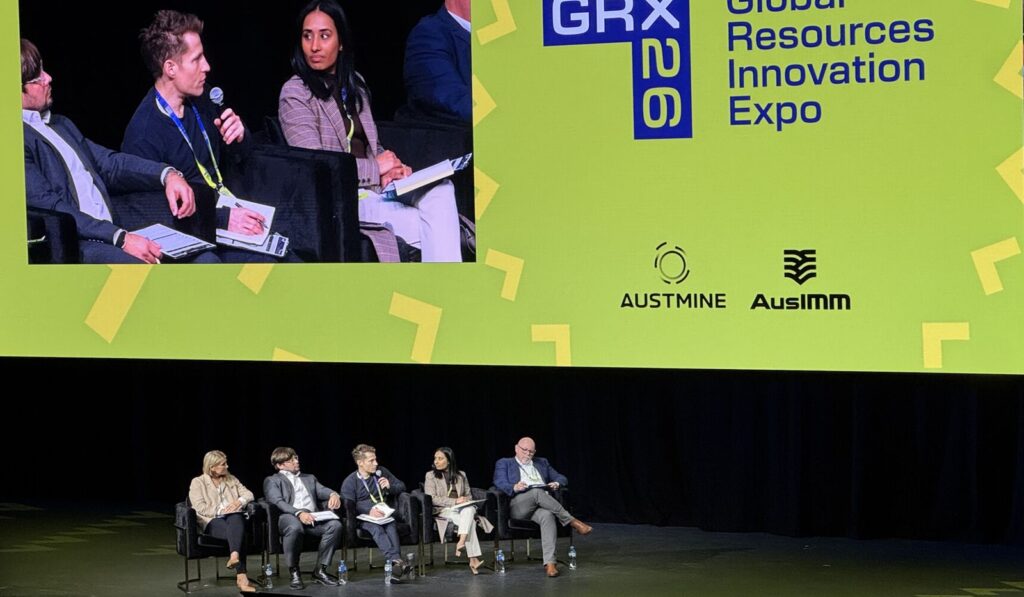
A Chilean nuclear physicist, a Canadian spectral chemist and a South African environmental scientist presenting in a Shark Tank-like global innovation challenge in Perth, Western Australia, highlighted the growing spectrum of expertise being applied to solve mining technical problems and the calibre of individuals being drawn into the industry’s increasingly lucrative start-up arena.
NanduX Technologies co-founder Miguel Arratia, Elemission CEO Francois Doucet and Dundee Sustainable Technologies vice-president Brent Johnson were joined onstage at the GRX26 event by Tomasz Trzesniowski from Poland’s Widmo Spectral Technologies, Canadian serial entrepreneur Mike Tourigny from Alberta-based Acceleware, and Australian mining engineer and IBT Robotic Systems founder Jollan Kingsley.
Ironically, Kingsley was the odd one out in this mining tech shootout.
GRX26 Global Open Innovation Colab challenge organisers Austmine and AusIMM whittled a list of 56 international submissions down to the six finalists.
Introducing the presentations, avid Australian mining technology watcher Paul Lucey said he felt like he’d “seen it all” in more than 30 years in the industry. But “there’s a couple of things here I hadn’t seen”.
Elemission, which took home the winner’s cheque, Dundee, Acceleware and NanduX are all promoting “disruptive” technologies.
“The demand for critical minerals is exploding and mining companies are making billion-dollar decisions based on incomplete understanding of the orebody variability,” Doucet said. “Elemission delivers real-time intelligence using laser-induced breakdown spectroscopy.
“Understanding the variability of the orebody is vital. This paradigm shift is happening. It’s not an option.”
Arratia said of NanduX’s muon tomography tech: “Time will tell how disruptive this technology is going to be but what I can tell you is that this is the first truly new technology – not incremental – in geosensing in decades in the mining industry. So I am betting everything that this technology is going to move the needle.”
Others are making mining market inroads with muons but Arratia maintained the one-year-old start-up’s sensors were unique and had been designed “for mass production”. NanduX also had a “Chile wedge”, taking locally made technology into the field in the world’s biggest copper producing country.
“The future of copper is deep. Whoever sees deep wins,” he said.
Dundee’s GlassLock process did what its name suggested, turning toxic mine waste – arsenic, for a start – into infinitely recyclable glass. “We wanted to challenge the orthodoxy of how arsenic waste is treated,” Johnson said. “From a do-nothing approach, which is to leave this material out in the open, through to intermediate compounds, like the work in Chile on calcium arsenate [or calcium arsenite], the hazardous material remains and still has the ability to leach. We don’t see it as a final solution. It is kicking the can down the road.”
Acceleware, a Toronto-listed microcap looking to expand use of its electromagnetic (EM) heating technology beyond Canada’s oil sands mines, has mineral drying and heap-leach heating pilots underway with miners, including BHP. Tourigny said the company’s silicon carbide transistor-based inverter had been developed, de-risked and commercially demonstrated over a decade.
“The bottom line here is that we think we can fundamentally change the way heat is delivered profitably,” he said.
“And we are here looking for partners to help us take the technology from pilots through to commercial deployment,” he said.
Trzesniowski, a Widmo co-founder, said spectral ground-penetrating radar (SGPR) technology was increasingly making a bigger impact in civil construction. The company picked up €5.5 million of EU grant funding for its “Cities” offering three years ago. Mining has seen slower adoption.
“If the GPR is so good, why is it so underused in mining?” Trzesniowski himself posed the obvious question. “For the very good reason that it just simply does not go deep enough. Our goal was to make the difference, to see deeper, to be able to use it in this industry and we achieved that. We have over twice the penetration depth at the same resolution as other geophysical GPR methods.
“Obviously we’re not as deep as some geophysical methods but we bring actually really high resolution so we can really look at potential problems and risks.”
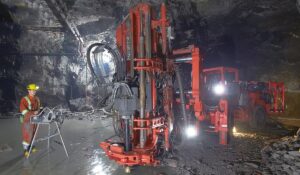
Similar to others on the podium, Kingsley said IBT had built a better mousetrap with its OptiClino blast-hole drilling down-hole survey tool. He outlined case studies showing millions of dollars a year of production and efficiency benefits that demonstrably flowed from more accurate drilling in underground mines. Automation continued to change the game.
“We’re getting twice the accuracy of [drill] OEM alignment systems and aftermarket fibre-optic gyro systems and we’ve achieved this all without any survey mark-up, which is a step change in the process,” Kingsley said.
“No one [has used] computer vision to align a drill. We do have patents but it took us a couple of years to get this right. A lot of R&D went into this. It would be really hard to copy. I think that’s probably the barrier [for a new competitor].”
Kingsley said the global market for OptiClino – underground hard-rock mines – could support the growth of a $100 million-a-year tech enterprise.