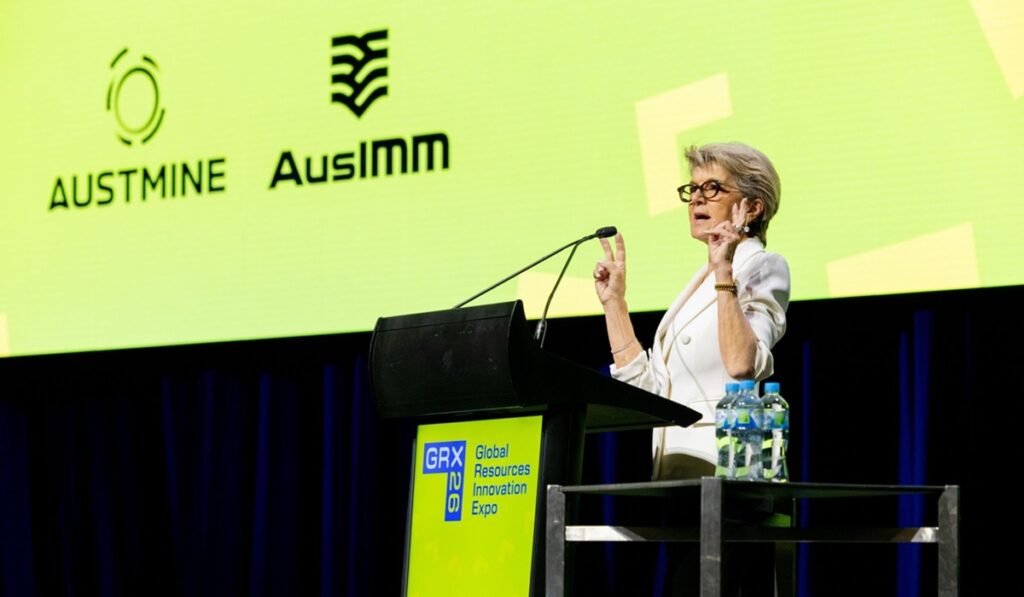
Three tectonic shifts that have fundamentally changed the international operating environment for miners and their suppliers mean companies must “treat geopolitical intelligence as importantly as you treat your bottom line”, former Australian foreign minister Julie Bishop told the GRX26 conference in Western Australia.
Bishop, who now runs a corporate advisory firm, told the Perth mining event fracturing of the world’s 80-year-old rules-based order, the weaponisation of resources and a technology-led fourth industrial revolution that had put minerals and metals at “the epicentre of great power competition” meant resource diplomacy was no longer just trade diplomacy.
“Today it is inextricably tied to national security diplomacy,” she said.
“The countries and companies that control the extraction and processing of those minerals will hold disproportionate power in the decades ahead.
“In trade talks we used to focus on market access and tariff schedules and the like but it’s now supply chain resilience, strategic stockpiling and the importance of trusted, reliable, long-term partners. Mines and processing facilities and transport infrastructure are now viewed as assets in a strategic calculation that extends well beyond a company’s balance sheet.
“The pressure is on companies that will be increasingly drawn into political calculations that you previously probably wanted to avoid.
“Governments will ask you to take sides – not implicitly, explicitly – and will have views about where companies invest and with whom you partner. A number of significant resource transactions have been blocked, delayed or restructured because of the geopolitical implications.
“Regulatory approvals once turned on environmental impact assessments. They now also turn on national security reviews.
“The opportunity for you is that governments, including the Australian government, are more willing to actively support and partner with private sector companies, essentially to secure resource supply chains. Critical mineral strategies in Australia, the US, Japan, India, the EU, are all about diplomatic and financial capital. Partnerships, loan guarantees, diplomatic support for projects are much more likely now than they ever were before.”
Bishop said many decisions “that will most affect your operating environment” – about critical mineral strategies, trade agreements, investment screening frameworks and development finance, among them – were being made in government offices not boardrooms.
“Industry needs a seat at the diplomatic table,” was one of the veteran politician’s five “new rules of resource diplomacy” laid out at the conference, organised by bodies representing Australia’s $100 billion mining equipment, technology and services (METS) sector, Austmine, and vast cohort of industry professionals, AusIMM.
“If you’re not at the table you’re on the menu,” observed Canadian consul general Ghislain Robechaud, who joined the GRX26 conversation about minerals as instruments reshaping international diplomatic engagement.
Bishop said her other four resource diplomacy rules were:
- Geopolitical risk was operational risk.
- Sources of capital mattered as much as its cost.
- Community and country relationships were now strategic assets.
- Transparency was a competitive advantage.
She said decisions being made in Washington, Beijing, Moscow and Canberra were directly impacting projects, financing and supply chain relationships, “so you must embed geopolitical analysis into your core decision making”.
The identity of investors and joint venture and offtake partners was being “scrutinised by governments at every level” and commercial relationships were coming under a national security lens, Bishop said.
Amid the bigger geopolitical picture, project-level community and host government relationships were as important as ever, she said. “Smart companies are … building genuine, deep partnerships.”
“If the company has a credible, reliable record of transparent dealing, it’s more likely to succeed,” Bishop said.
“The Extractive Industries Transparency Initiative and the like are not temporary. They are core governance commitments.”
Like Canada, Australia had untold mineral riches, deep technical expertise, stable laws and strong historical ties with trading partners built on shared interests and reliable supply, GRX26 heard. “It should give enormous advantages,” Bishop said. “But it does require effort.
“We’re at a genuinely historic juncture.
“There’s a lot that Australian and Canada can do in onshoring processing and downstream processing to give truly sovereign self-sufficiency in the resources sector.
“This idea that we’re going to get supply chain sovereignty when all of the refining and processing is still done in China is illusory.
“[But] it’s incumbent on governments of countries like Australia and Canada to be [part of] credible, reliable, trusted supply chains, whether it’s the critical minerals, the processing facilities … I was in Davos when [the Canadian] prime minister made one of the most extraordinary interventions I’ve ever seen in a global setting. He basically called the Trump administration’s approach to foreign policy for what it is and saw it as an opportunity for countries like Canada, Australia, Japan, South Korea, the European Union – like-minded countries – to partner with each other, to support each other in their commitment to stability and certainty and a rules-based order.
“I haven’t seen standing ovations like that since the Oscars.
“What is important is that it highlighted what Australia and Canada can do together.
“I don’t want anybody to think that Canada and Australia are not competitors. We are, but it’s not adversarial. Competition makes us better.
“The announcement in March on [linking of the two countries’] critical minerals stockpiling regimes … is the sort of initiative between Australia and Canada that will be pursued at government level that will have enormous benefits for both resource sectors.”