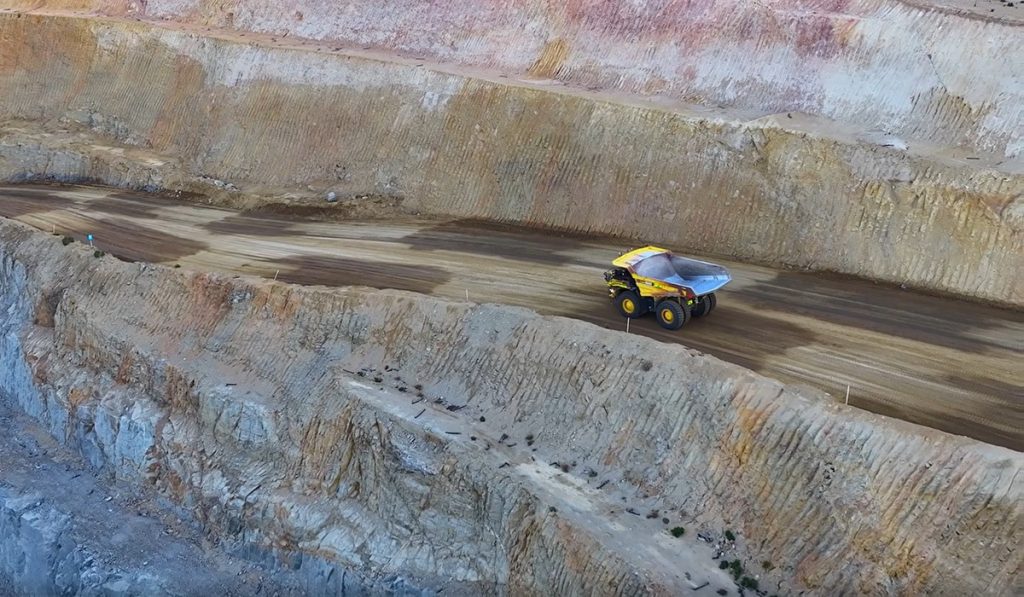
Welcome to mining autonomy 2.0. Not the technology shift, the investment shift. The new paradigm is being led by imminent Hong Kong listing, EACON Group Co, the 2018 start-up threatening to turn the industry’s mobile automation foot race into a sprint.
EACON’s Hong Kong initial public offering has raised US$293 million and the 2018 start-up will start trading on the $6 trillion market in the morning.
Its prospectus promoted EACON’s strong growth in China’s nascent mining mobile autonomy market and foothold in the main Western market, Australia, where it is looking to demonstrate the economic credentials of its ORCASTRA technology through Zijin Mining and contracting heavyweight Thiess.
Mining’s impressive mobile-fleet automation build-up has been dominated by original mining equipment manufacturers and their proprietary systems. But the circa-20-year mining automation journey – surface and underground – has pushed the percentage of equipment on autopilot worldwide into the low single digits.
US advisory group Frost & Sullivan thinks the global autonomous mining solutions market can grow from a c$1 billion base in 2025 to more than $7 billion by 2030. Silicon Valley software firm Applied Intuition, which entered into a partnership with Komatsu last year, has an estimated $1.6 billion mining-vehicle autonomy market expanding eightfold by 2031.
“Scaling autonomy doesn’t only mean tackling the biggest sites, it means making the smallest ones work too. We’re building technology to make every type of site more intelligent and efficient,” Applied Intuition construction, mining and agriculture head, Joe Forcash, said.
Hitachi Construction Machinery technology unit, Wenco, says the next breakthrough in autonomous mining “might be five years away—or 15”. Closed OEM ecosystems had often “limited the scope of innovation to what fits [an OEM’s] proprietary roadmap”.
“Open autonomy, on the other hand, fosters a broader innovation ecosystem where third-party developers, research institutions and integrators can contribute breakthroughs that benefit the entire industry. Decoupling autonomy from equipment brands allows miners to adopt emerging technologies as they mature, without being limited by the timeline of a single vendor.”
EACON wants to compress mining’s autonomy scaling horizon.
The company claims to already have its systems working on more than 2500 mine trucks at coal, hard-rock and quarry sites in China. It has about 730 employees and turned over $204 million last year.
It is set to lift off in Hong Kong with a plus-$1 billion market value.
IPO backers are said to include international asset managers such as Fidelity International, JP Morgan and Barings, along with Indus Funds, Jain Global, Regal and Seven Grand, plus Chinese investors GF Funds and CDH. Australian Securities Exchange-listed resources investor Regal, which has more than A$21 billion under management, is reportedly participating as a cornerstone investor in a Hong Kong IPO for the first time since it was established in 2004, a potential harbinger of EACON’s growth prospects in Australia.
Other institutional investors include Zijin Mining and XCMG.
“As artificial intelligence converges with the physical world, autonomous driving is emerging as a critical link in the physical-AI value chain,” EACON says.
“Through its scaled deployment of autonomous trucks and digital mining platforms, EACON has built a closed-loop system spanning mining-focused embodied intelligence, physical AI and spatial intelligence — a barrier built on physical data collection, mechanism-based reasoning and global coordination, positioning the company for accelerating near-term automation in openpit mining and significant medium-to-long-term upside.
“As autonomous mining trucks take on work in hazardous environments, the technology is becoming a core driver of the broader shift toward intelligent, large-scale mining operations — enhancing safety while opening the door to commercialisation across the sector.
“Backed by a deep bench of capital, EACON is positioning itself at the forefront of that transition.”