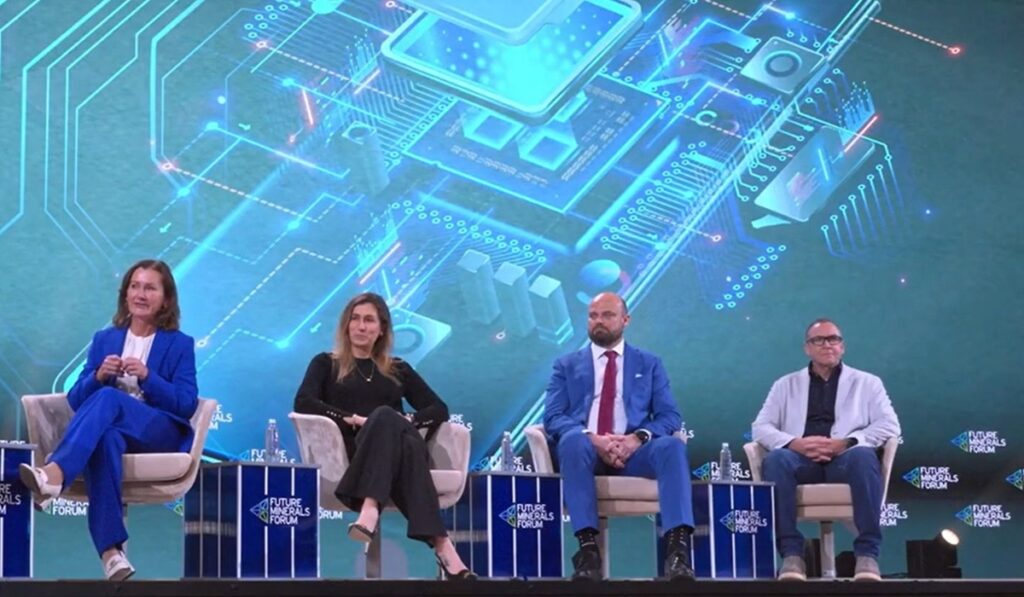
It was always going to be a big talking point and didn’t disappoint. AI can help the mining industry fast-track exploration, extraction and process plant optimisation and build humanity’s “biggest foundation model”, the 2026 Future Minerals Forum in Saudi Arabia heard.
On the flipside, it shapes as a key demand driver for metals such as copper.
Ivanhoe Mines boss Robert Friedland told FMF26 the world could need half a dozen new large copper mines a year, every year, through to 2050 to meet new demand for the red metal from urbanisation, electrification and AI. “Forty percent of the production of those new mines will be required for electrification and data centres and grid upgrades,” he said.
US investment bank Morgan Stanley said this month global data centre power demand could rise by 27GW this year after surging by 19GW in 2025. Its strategists were predicting early in 2024 US data centre power needs would surge by 8GW in 2026 and 2027 and had upgraded those forecasts to 15GW and 21GW, respectively.
“Data centres could account for 2.1% of total copper demand growth in 2026, supporting a tight market in 1H26,” the bank said. “On our commodity team’s estimates data centres consumed about 500,000 tonnes of copper in 2025 which is expected to rise to one million tonnes by 2027 and 1.3Mt by 2028.”

S&P Global says “exponential growth” in AI, defence spending and robotics will lift global copper demand by 50% by 2040, leaving a supply shortfall of more than 10Mt a year without major gains in mining and recycling. The November 2022 debut of ChatGPT launched the “AI Race”, which runs on electricity. S&P says: “In 2025, half of US GDP growth [was] attributed to AI spending – largely on computer chips, data centres and the electric power systems on which they run. This explosive growth of AI and data centres has introduced a new, rapidly expanding vector of copper demand.”
Red Cloud Securities analyst Kenneth Hoffman said there was AI talk all over the King Abdulaziz International Conference Centre in Riyadh.
AI had real uses in mining “and they are pretty cool … especially in the finding and financing of mines”, he said.
“The use of AI is not only to instantly scrape data as it is released to the market in order to save time and have analysts focus on analysis rather than sourcing data, but also just shocking sorts of uses of data.
“We met with one company that had, in one week, scraped four million pages of mining data which was up to 100 years old, in Kazakhstan, and had all of the data translated, formatted and ready to use by models looking for new mines.
“They will now work on an additional 75 million pages of data.
“As more parts of the world open up to mining and as metals become ever more scarce this will become a major advantage.”
CEO and co-founder of Australia’s Fleet Space Technologies, Flavia Tata Nardini said a shift to “agile geoscience” was underway in mining, built on continuous data acquisition, real-time intelligence and AI-enabled decision-making that accelerated discovery while reducing cost and impact.
The 10-year-old Fleet Space, which has raised more than US$160 million of equity funding, is working with mining majors including Saudi Arabia’s Ma’aden.
“When we co-founded Fleet I wasn’t sure we had to use AI,” Tata Nardini said at FMF26.
“You have to use it if the amount of data is so big that your people cannot have a sense of it in real time [and] in the time that you need it. But working in the kingdom, working all around the world, we started collecting so much data. The amount of subsurface data is astronomical.
“So the human brain couldn’t do it by itself.
“In exploration we historically have counted so much on peoples’ knowledge, on [their understanding of] maps, their instinct, their travels and understanding of the geology. And this is still an art. AI will not cover this art. Arts are arts.
“How can you bring this tool together with the geologists and the operators to make sure that you increase confidence?
“Think about the kingdom … Hundreds of thousands of square kilometres: Where is this amazing copper hidden? We’ll find it. We know we will find it. But in 50 years or in three years?
“I think that’s the key.
“There is not a foundation model of AI of the world yet [but] it is going to happen in the next five years”
“If you want to do it in three you need tools and there is not a better time to use AI as a tool as long as we don’t think it’s a silver bullet. We increase confidence in our choices.
“We live in a very special time. In just the past couple of years we’re using ChatGPT and now we’re using all the technologies coming from Silicon Valley.
“This is now. It’s happening as we speak. The moment for AI is not talk any more, it’s actually happening.
“[And] when we talk about AI application the subsurface of the Earth is going to be the biggest AI foundation model of humankind.
“We will learn not just about minerals but about water, about oceans, about everything. It is so exciting.
“There is not a foundation model of AI of the world yet [but] it is going to happen in the next five years.”
Ma’aden chief technology officer Donovan Waller agreed AI was not “a magic wand and it doesn’t solve problems miraculously”.
“But when you find the right use cases, you have the right data scientists and the right data that you need in order to make it work it can be transformational,” he told FMF26.
“AI is a major play in probably every single one of the processes that we’re looking at. There’s nothing that won’t have some form of AI and some form of enablement as part of what it is.”
BHP chief development officer Catherine Raw said technology was set to play a far bigger role in unlocking new value in mining than it had done historically. She said industry culture – risk-averse operationally and generally conservative – was the biggest barrier to faster technology adoption.
“What’s the biggest unlock in terms of value? It’s probably data,” Raw said.
“If we were to collaborate and share data and then apply technology and innovation, AI, to that data, that would probably solve a lot of the discovery problems and a lot of the processing problems that we have because we’re then able to make better informed decisions.”