High-resolution muon tomography sub-surface imaging could significantly reduce the amount of drilling needed to outline a mineral resource, in the right geological environment, and certainly help make drilling more effective, a Canadian geologist has told a webinar audience.
Speaking after Fireweed Metals Corp announced a successful maiden muon tomography survey with partner Ideon Technologies at its flagship Macpass zinc project in Yukon, the company’s vice-president geology, Dr Jack Milton, said the survey method had proven its value as a drill target generator. When it resumes drilling in the Canadian summer Fireweed will zero in on three areas highlighted by the muon work that started in October last year. It will also broaden Ideon’s survey focus in what Fireweed calls a prospective corridor in the regionally significant Selwyn Basin that hosts its Boundary Zone and other known deposits.
Toronto-listed Fireweed, which has a current market value around C$300 million, is backed by Lundin Group.
Fireweed also has the major undeveloped Mactung tungsten resource in the same district.
Milton said muon tomography had added significantly to the junior’s understanding of an area that had been gravity mapped, surveyed with VTEM electromagnetic geophysics and LiDAR, and drilled in certain locations to outline the current Macpass indicated resource of circa-56 million tonnes grading 7.27% zinc-equivalent (including significant lead and silver) and inferred 48.46Mt at 7.48% Zn-eq. Fireweed sees that it is only scratching the surface vis-à-vis the zinc potential in the district, as well as definition of further gallium and germanium content that is already strategically valuable.
“The muon technology has the potential to detect density anomalies deeper and at much higher resolution than we would otherwise get,” Milton said on the webinar. It had ticked the new target generation box. “We also wanted a robust 3D model of the known mineralisation … to give us greater confidence in the continuity between drill intersections and use it as a secondary way to validate the tonnage of the deposit. It is really a technique than can let us see that unknown ground in between the drill holes.
“And then thirdly it helps us validate different geological hypotheses, including validating the structural model of the geology around the mineralisation. We have the potential now to go back into that resource and apply this to better constrain the geology, to better understand extensions and characterise the material that we do have.”
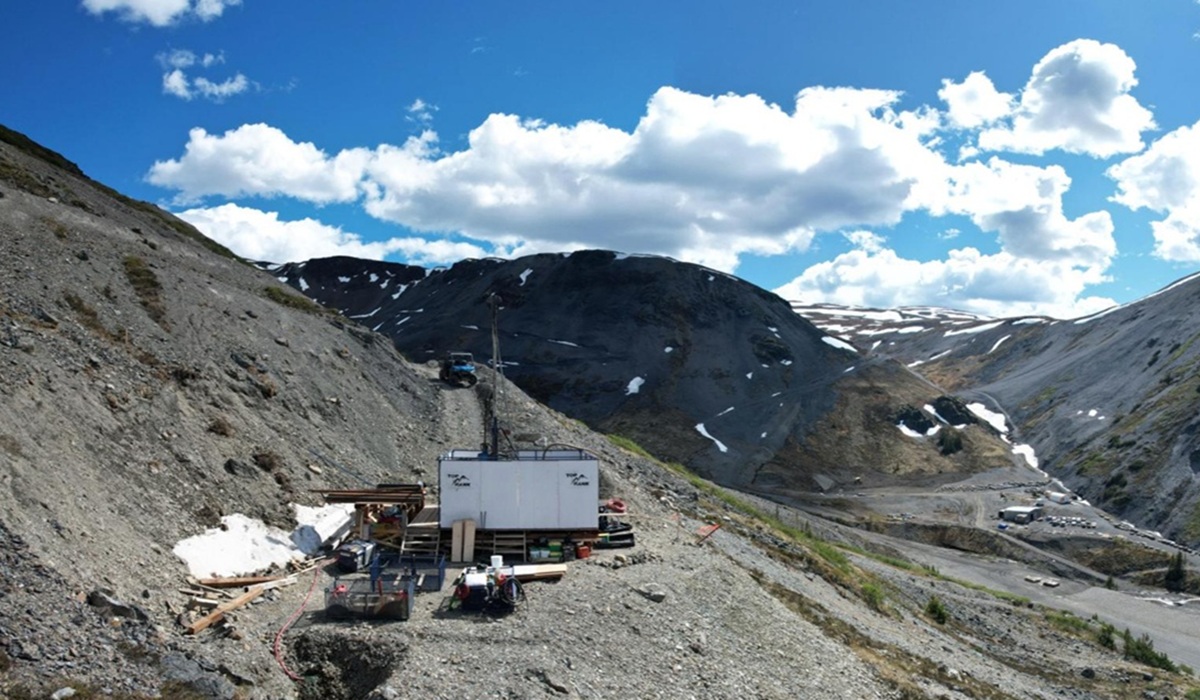
The webinar heard Ideon used three existing Boundary Zone drill-holes as its survey platform, placing seven muon detectors in each hole to map about 2.5 square kilometres of the sub-surface down to 550m depth and over a c1km strike length, at 10-20m resolution. That examined, volumetrically, about 600 million cubic metres of rock.
The survey work was done remotely with solar and diesel power, using satellite communications and cloud computing, while temperatures dropped to as low as minus-40C over winter.
Ideon co-founder and chief technical officer Dr Doug Schouten, who led development of the firm’s second and third generation muon telescope systems, said integrating the muon data with other survey information had a “one-plus-one-equals-three effect” – combining from-surface imaging with sub-surface views – which produced higher quality, higher resolution 3D models of the Earth.
“What we’re really trying to do is solve the geological uncertainty problem,” he said.
“Uncertainty of understanding the sub-surface is the dominant driver of cost risk and time delays in mining. We believe by providing new high-resolution datasets … that we can make a really sizeable impact in the mining industry.”
Milton said as well as helping to generate new targets, muon tomography produced a “robust” 3D model of the main mineralisation and secondary mineralisation zones. It provided valuable validation of geological hypotheses.
“I think implementing this at the right stage of drilling out a resource – and ideally if you put it into the discovery hole, or shortly thereafter – you stand a chance of then being able to really minimise the amount of metres you would have to put into the deposit to turn that into a resource,” he said.
“You’re always going to have to drill out the deposit to a certain degree to get the chemical information, the assay information, from those holes to build up your variography. But once you’ve established that I think it could be used today with a QP [qualified person] with the appropriate experience and knowledge to be able to confidently sign off on a resource.
“Could we have done the Boundary resource just with those three holes? No. We need more drilling than that to establish the grade information and to give us better confidence.
“But maybe instead of 50 drill holes we could have had 40 or even 20 drill holes to give us a very similar type of answer to get us to an inferred resource.”
Fireweed CEO Ian Gibbs said last week technological innovation in mineral exploration would be key to discovering a new generation of mineral deposits.
“We are proud pioneers of integrating progressive methods such as this downhole muon tomography technique in mineral exploration, leveraging this industry-leading technology developed by our partners at Ideon,” he said.
“The early results from the survey have provided some compelling targets that we are excited to test during the upcoming field season at Macpass.”
Vancouver-based Ideon, which raised US$16 million in 2022 in a private equity raising led by US VC Playground Global, has worked with a number of large and small miners on deployment of its Reveal platform in various mining, geotechnical and exploration applications. Its growth has made it one of the hottest scale-ups in the mining technology space.
Schouten compared muon tomography to medical x-ray imaging analogous, with naturally abundant cosmic radiation used instead of artificial x-rays to do the rock scanning. Triangulation tomography built the “highest available remote sensing resolution” 3D model of the density of sub-surface structures.
Milton said Fireweed was using muon tomography to detect dense bodies of rock, such as zinc deposits, that produced “shadows” in muon data, where fewer muons were reaching imaging detectors. The high density of high-grade massive sulphides at Macpass made them well suited to detection using muon tomography.