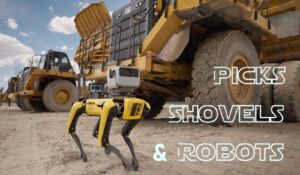
Are robot makers such as Apptronik, Boston Dynamics and Unitree going to join hands with miners as future joint venture partners?
We’ve already seen car makers and data centre owners funding new mines, with that trend likely to ramp up. A new deep-dive into growth in humanoid robot use of critical minerals by Morgan Stanley points out the usual problems with expecting a fast response to high levels of new demand for certain commodities, namely lengthening new-mine lead times, higher costs and a lack of quality (economic) resources.
But capital also remains an issue and Morgan Stanley’s latest snapshot of the potential scale of the humanoid robot market by 2050 points to a major consumer and patron taking shape over the next two decades.
Big Tech and Big Auto, non-traditional JV partners for miners, are already in the queue with steel-makers and other manufacturers. Now “the robots are coming for critical minerals”, Morgan Stanley says, adding to urgency around supply chain diversification for Western companies in particular.
Bank analysts in the US and China think the nascent humanoid market could be more than 1 billion units worth $4.7 trillion by 2050. They say with generative AI driving changes across the robotics industry, “embodied AI or humanoids” may be adopted more rapidly than autonomous vehicles across a broad range of industries, underpinned by labour tightness and demographics.
“Humanoids could create a significant uplift in demand for critical minerals – especially rare earths – and cumulatively add up to US$800 billion of incremental demand across covered critical minerals by 2050,” they said in a research note.
“We see the take-up of humanoids starting to gather pace from 2035 onwards and as a proportion of 2030 demand for rare earths – specifically neodymium [Nd] and praseodymium [Pr] – humanoids could add an additional 40%, 110% and 167% in 2040, 2045 and 2050 [respectively].
“These numbers, for incremental demand just from humanoids, could be about 20% for lithium, 15% for cobalt, 10% for nickel, 5% for graphite and 5% for copper of 2030 demand. By 2050 the annual added demand for critical minerals could be to the tune of [up to] $120 billion per annum.
“Cumulative demand from 2035 to 2050 for these minerals could be between US$350-800 billion.”
“We find critical minerals markets need significant supply additions to meet this fast growing demand.”
Morgan Stanley said humanoid battery packs were expected to be a significant incremental source of demand for lithium while copper would be used in a number of applications including battery, motors and actuators, wiring throughout the body and charging infrastructure.
“We estimate 1-3.1kg of lithium will be required per humanoid,” bank analysts said. “Humanoid-related lithium demand rises from about 15,000t in 2035 to about 500,000t by 2050, boosting our 2030-2050 global lithium demand CAGR from 5.0% to 5.3%.
“This equates to a cumulative $79 billion addressable market by 2050.
“We estimate 4.5-8.5kg of copper is used in an average humanoid, with an additional circa-0.5kg used for the charging infrastructure. Adding humanoid demand pushes our supply/demand balance into deficit from 2036 … and humanoids equate to a cumulative US$149 billion addressable market by 2050.”