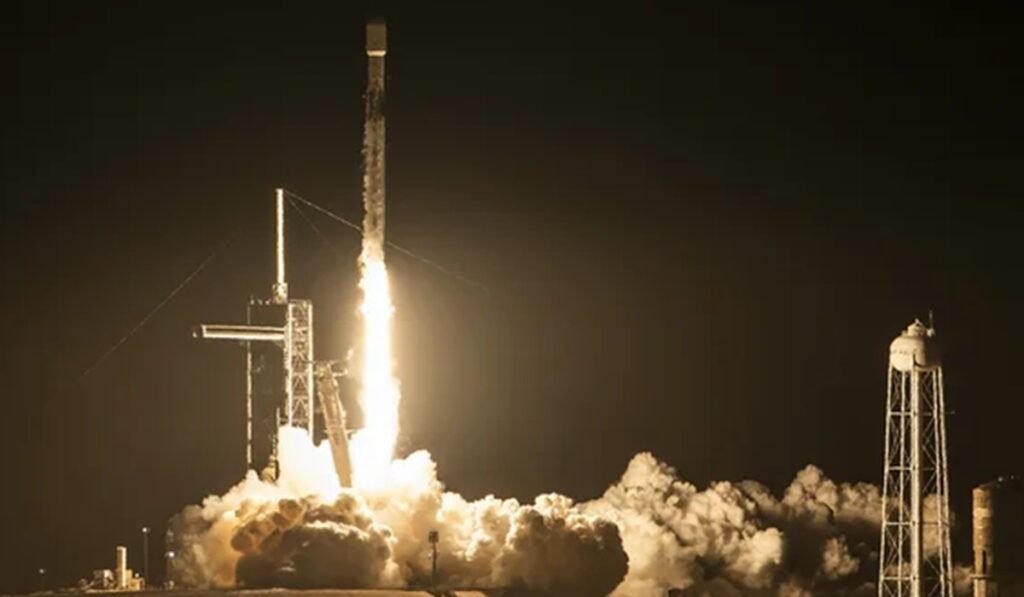
The next “space race” will see billions of dollars, even trillions, diverted into the metals and battery industries, a mining investment forum in Toronto, Canada, has heard.
Red Cloud Securities commodity strategist Ken Hoffman said metals and mining were a critical constraint on AI, robotics and military capability but capital could be expected to “shift from tech to basic materials and energy due to rapidly growing demand for scarce resources”.
He told a Red Cloud-hosted forum metal-mining indices were trading “near 20 [price-to-earnings multiples] versus tech at 60 PE”. A flip to favour materials was anticipated by the investment firm with “valuation inversion” the result.
“Investment inflows into [the] resource and energy industries are expected to accelerate rapidly, producing multi-fold growth in those sectors,” Hoffman said.
McKinsey & Company’s Greg Callaway said the circa-US$3 trillion global mining industry had recently “plateaued” but was undergoing shifting dynamics. The world’s middle class was expected to grow from 3.2 to 5.2 billion people, resulting in massive, material-intensive infrastructure upgrades. Renewable energy accounted for 32% of global power generation. Battery electric vehicles made up about 30% of China’s vehicle sales. In Europe it was 16%.
Surging data centre electricity demands were pressuring already ailing grid infrastructure, boosting copper demand, Callaway told the Red Cloud forum. “AI and data centres are just a cherry on top,” he said. “Consumption of materials is growing across the board.”
Callaway said on the supply side familiar problems weren’t going away, among them deeper mines with longer haul distances, higher stripping ratios and declining ore grades. Capital intensity would rise sharply to meet future demand.
Callaway said mining capital expenditure was tipped to rise by 6% CAGR, reaching $250 billion by 2035 for a cumulative capital spend of $3.5 trillion. Advanced analytics, AI, automation and electrification could help industry productivity rebound to mitigate cost impacts.
Hoffman said AI that was starting to become disruptive in numerous industries was also now capable of updating mine databases in real time, lowering mining costs, speeding up permitting, outcompeting technology companies and “perhaps most importantly for the metals and mining industry, spurring massive electricity demand”.
“AI is changing things,” he said.
“The typical approach to data scraping involved shear human willpower, including searching PDFs and company filings for drill results, resources and economic studies. The reality was that it took 2-4 months to complete, with 85-95% accuracy, and retrospective insight. Using AI documents are ingested instantly with full traceability and no ambiguity. Millions of data points are analysed instantaneously.
“As a result more than 99% of data is validated accurately with much faster insight and up to 80% lower costs.”
However, it was “all about the metals”.
Hoffman said geopolitics would play a large part in driving future metal demand and even suggested a US war with Iran would need to be short – which US president Donald Trump is now promising, or hoping, will be the case – with the country’s munitions stockpiles likely to be “depleted in a couple of weeks”.
“The US could run out of missiles sooner than we anticipate,” Hoffman said.
He told the forum “sources” suggested it could take up to two years to rebuild stocks due to rare-earth and metal shortages. The US lacked domestic production capacity. To continue stacking up defence inventories it had to make sure metals required for defence equipment were readily available.
“One way to make more missiles is to build them by gathering up all the critical minerals needed and processing them in-house,” Hoffman said. However, “China controls about 98% of the world’s supply of these critical minerals which may make it tough for other countries looking to compete for scale,” he said.
Frank Giustra, CEO of Canadian-based Fiore Group, told the forum current geopolitical tensions, rising defence spending and growing fragmentation between the US and China reflected “late-cycle stress within the existing global order”.
“The world is entering a historic transition period akin to prior 80–100-year systemic cycles,” the veteran mine financier and entrepreneur said.
“Excessive global debt, now approaching $350 trillion, combined with prolonged monetary expansion, has destabilised fiat currency systems and set the stage for a major monetary reset.
“Policymakers lack the political will to materially reduce deficits, making currency debasement and inflationary outcomes increasingly likely.”
Giustra said he expected a prolonged period of disruption, potentially going into the early 2030s, characterised by economic volatility, geopolitical conflict risk and declining confidence in traditional financial systems. The eventual outcome would likely be a multipolar monetary framework involving competing regional currencies, with gold playing a renewed role as an anchor.