Stone Age, Bronze Age, Iron Age, Silicon Age: a discussion about the outlook for the world’s biggest economy posed the question, which epoch-making metal will be most critical in the era of new energy and AI?
Contributors to the newly launched, “Critical Minerals and the Future of the US Economy”, weighed in on the topic at an event in Washington, DC.
They included Dr Gracelin Baskaran, co-editor of the book and director of the Critical Minerals Security Program at the Washington-based Center for Strategic and International Studies (CSIS). Also, CEO of the International Council on Mining and Metals, Rohitesh Dhawan, Fannon Global Advisors principal and former US assistant secretary of state for energy resources, Frank Fannon, Metis Endeavor managing director and CEO of Principal Mineral, Adam Johnson, and director of the CSIS energy security and climate change program, Dr Joseph Majkut.
“It feels like we’re at that precipice of a new age,” said discussion moderator, Eric Palomaa, director of the Hess Center for New Frontiers at CSIS.
Johnson, who wrote about America’s midstream metal processing bottleneck in the book, suggested rare earth elements (REEs) would define that age.
“In the 90s China started their adventure that we are living in right now on the premise that they were the Saudi Arabia of rare earths,” he said in Washington. In the book he wrote that China refined 92% of global REE supply. “Beijing has imposed export restrictions on rare earth processing and magnet technologies, underscoring its readiness to use its near-monopoly position as leverage in ongoing trade disputes, particularly with the United States and the European Union.”
The lack of domestic processing capability to convert raw minerals into advanced materials meant “some of the most crucial US technologies remain vulnerable to the influence of foreign adversaries”.
Makjut said lithium, for him, continued to be the commodity of the new energy age.
Despite a catalogue of emerging battery chemistries he believes lithium will feed the batteries that are going to be “so ubiquitous in our economy … Under the refrigerator, in the driveway, in everything you’re carrying around, in the robots that we’ll be using in the not distant future.
“We are heavily dependent now [on offshore supply]. When I was born we were the top lithium producer in the world because it was just an esoteric pharmaceutical good. But through dedicated investment and business innovation here in the United States, we stand to be not just self-sufficient but perhaps even an exporter of lithium in the coming decades.”
For the Baskaran and Fannon, the future is all about copper and a “new” Copper Age (after its part in the transition between the Stone and Bronze Ages).
“You can’t electrify anything without it,” Fannon said.
“We talk about data centres and … the commanding heights of the new economy.
“Copper is the conductor of that future.”
Baskaran said: “[Copper] is the commodity I tie most to economic growth. The book is called, Critical Minerals and the Future of the US economy. It’s a copper story.
“When I think about artificial intelligence … I saw recently that you need 16,000 tonnes of copper per gigawatt for Stargate. The amount of copper we need we can’t even wrap our heads around. And we have it at home. There’s a domestic copper story here that’s really important.
“But we also need to build our midstream capabilities or we’re going to be sending our copper back to China.”
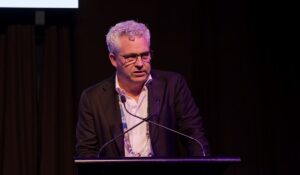
For the head of the ICMM it’s a new Iron Age.
“Iron is used to make steel and steel is the ugly cousin of critical minerals because nobody thinks of it as a critical mineral,” Dhawan said. “But you cannot make anything without steel, not least wind turbines or solar panels. So let’s not forget about the steel industry, which continues to face a huge challenge not just to decarbonise but to remain competitive.”
Trust, though, was “the most precious of all commodities” for the global mining industry, said Dhawan, who asked the Washington audience for their indulgence. He said: “It really is cheesy but I cannot drive home the point enough about the fact that never before has the world needed so much from a sector it trusted so little.
“I’m not sure we understand that.”
Dhawan had earlier asked the crowd to raise a hand if they thought the mining industry per se was acting responsibly, taking care of the environment and respecting landowners’ rights. And one person raised their hand. “There lies the problem,” Dhawan said.
“This is an informed audience who cares about this topic, who has read and thought about these issues very deeply. Now transpose this to people that haven’t had this closeness to the issue. Stop somebody on the street and ask them, what do you think of the industry. You’re going to get a negative reaction. And unfortunately we as an industry have done a bad job of giving people that comfort that we will act in society’s best interests while we produce the minerals that are so essential to our modern economies.
“And if we don’t change this reality I don’t believe any level of policy, any level of investor support, is going to change the speed at which we can develop new mines because as this city knows better than any other in the world, all politics is local, and we have not won the hearts and minds of people at a local level by and large for mining.
“We’re not going to be building … 40 new copper mines every year for the next 10 years.
“There’s no way communities are going to welcome us in their backyards to mine this stuff. So let’s absolutely get the economics right. Let’s get the geopolitics right. But as typical engineers and finance people we forget about the human element of all of this. And without that none of this gets done.”