Vancouver start-up Basilisk Industries is celebrating being accepted into the Creative Destruction Lab’s 2026/27 minerals stream. The global program for seed-stage, science-based companies has 23 streams, with the minerals stream aiming to help founders looking to commercialise “hardware or software innovations that are enabling improvements in the efficiency, safety, productivity and sustainability of mineral exploration and the mining industry critical to society’s future”.
Basilisk, which wants to “change the way the world cuts rock”, is a mid-2026 start-up incubated out of the Paris-based Marble Venture Studio. Founders, entrepreneur Michael Delage and engineer Alex Mossman, recently hired British-born rocket scientist James Garry as their in-house physicist.
“We have a lot of tricky challenges ahead as we develop our technology,” Basilisk CEO Delage said.
“James has worked on a remarkable variety of projects, from interplanetary probes such as the Huygens mission to Titan, to remote sensing, to plasma physics and high vacuum systems and even biomedical sensors.
“He even built his first car.”
The nine-month Creative Destruction Lab program starts this month.
“Rock excavation and drilling is fundamental to the global economy and the energy transition,” Basilisk chief technology officer Mossman says.
“Whether we’re talking about critical metals such as copper, nickel, iron and cobalt or abundant, emission-free, dispatchable energy, such as geothermal, tomorrow’s economy is going to demand a lot more. The supply chain starts with our ability to cut through hard rock.
“The core elements of rock cutting today would be recognisable to miners in the Victorian age. Mechanical drills grind and crush and explosives break. In hard rock drills wear out quickly and fail unexpectedly. Blasting still causes unpredictable results, over-breaking and safety risks. Rates of advance are slow.
“It doesn’t have to be this way.
“New technologies have opened the door to directed energy approaches. Just as efficient as mechanical drills but up to 10-times faster, our approach can transform the way we cut rock, changing the economics for hard rock mining and deep geothermal energy.”
VoltVision plugs into Datamine network
UK-based VoltVision says it will have a chance to leverage leading mining software vendor Datamine’s “extensive global mining network” under a new partnership.
While details on the pact are scarce at this stage, VoltVision says it will collaborate with Datamine on global sales and marketing “including an integrated software solution spanning the whole mining lifecycle, from exploration and mine planning through to production and ongoing operations”.
Datamine adds specialised asset monitoring and analytics products through VoltVision, which “digitises high and medium voltage industrial power networks” with its V-CUBE “plug-and-play” data extraction gateway and ViViD cloud-based AI platform.
Oxfordshire-based VoltVision says it won new tier-one mining sales deals and completed deployments in Africa and the Middle East in 2025 in an important year for the company.
Datamine is part of Toronto-listed Constellation Software.
Myco looks to shine more light on fungal leaching
Western Australian “fungal biotechnology” firm Myco Metals is looking to win one of the state’s Innovators of the Year Awards in November after recently taking out a tech pitch battle in Perth.
The “Great for the State Award” from the state government goes to a local innovator whose “bold innovation showcases the state’s creativity and ingenuity and offers clear benefits for WA’s economy, community and/or environment”.
Geologist Tony Pfaff and chief scientific officer Dr Abigail Pfaff started Myco about a year ago. The founders say their fungal bioleaching technology is the first of its kind in Australia and “will lead to a step change in mineral economics while achieving decarbonisation and energy transition goals”.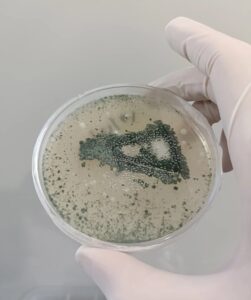
“Mycoleaching” uses acids produced from the growth of mycelium, funghi’s root system, to leach metals from rock, including low-grade mine waste. It is said to work at ambient temperature and doesn’t involve chemicals such as sulphuric acid and cyanide.
Tony Pfaff, fresh from winning a Future of Mining pitch battle, says start-ups are hard and “deep tech is harder”.
“There’s a lot of uncertainty, a lot of nights wondering if the science will hold up or the funding will come through,” he says.
“So this [recognition as a finalist in the WA awards] is a nod to everyone else out there building something from nothing and not knowing if it’ll work. Innovation is awesome but it’s rarely glamorous getting there.”
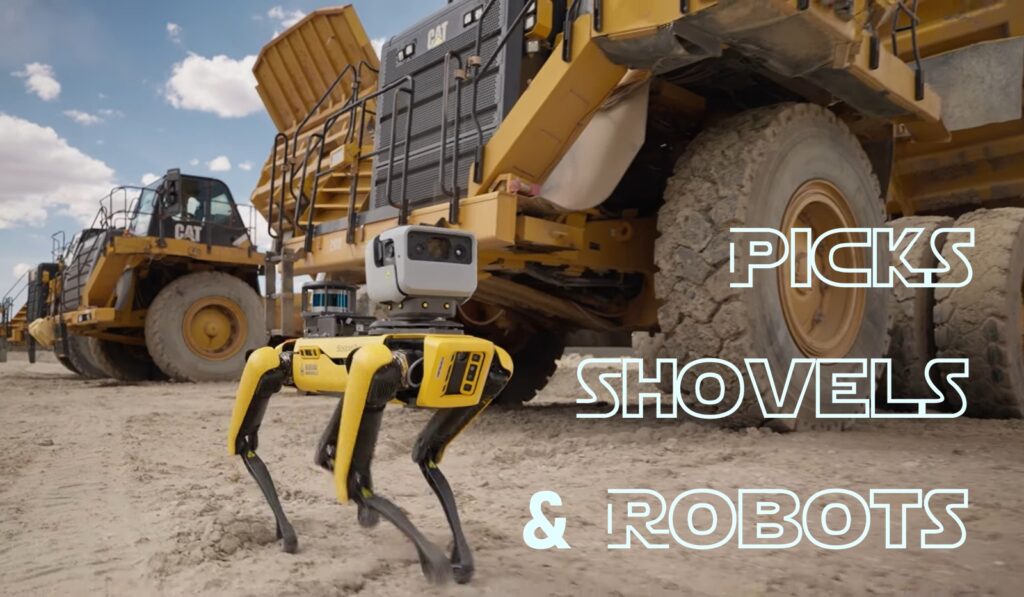
About Picks, Shovels & Robots: “When everybody is digging for gold it’s good to be in the pick and shovel business”. In the 1800s thousands rushed to California – and other parts of the world – to find gold. Most miners went broke or didn’t survive. Merchants who sold shovels, pans, denim pants and staples made a fortune. Some of the technology has changed but suppliers of essential prospecting and mining tools and services have never been more in vogue.