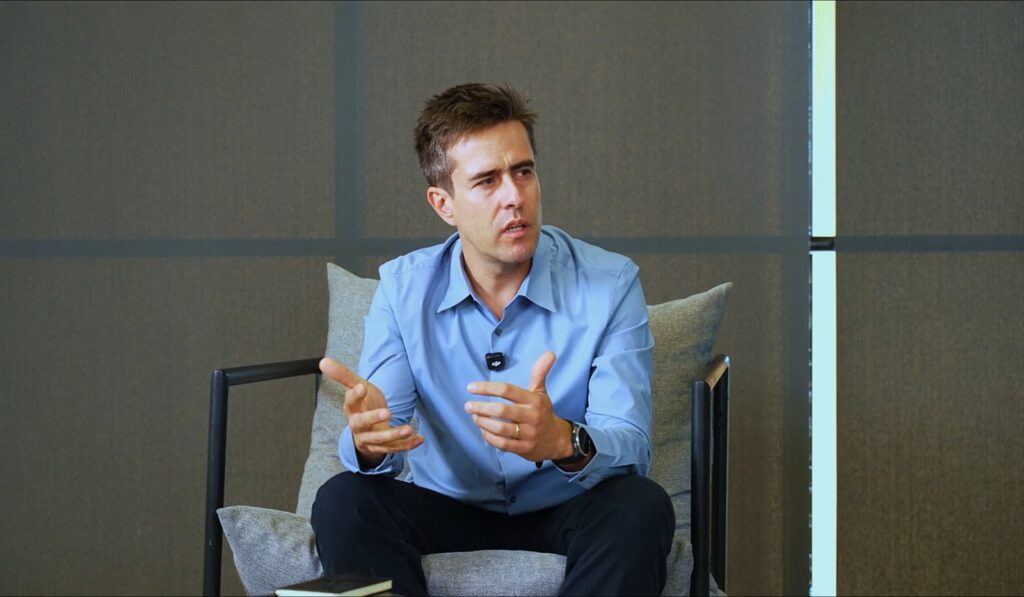
Leading corporate adviser in the global mining technology space, Atrico, expanded into Latin America this year under the leadership of Nicolas Jubera, who previously led TIMining’s software development and deployment to companies such as BHP, Anglo American, Codelco and Glencore.
The board member at Chile’s Centre for Copper and Mining Studies (CESCO) brings a “rare combination of mining technology domain expertise, founder experience and deep relationships across the Latin American mining ecosystem”, Atrico says.
Australian-based Atrico is a unique voice in the world’s fast-changing mining and metals technology space, advising more than 250 technology companies in over 430 engagements and playing a key role in deals worth more than $1 billion in the past three decades.
InvestMETS.com caught up with Jubera, who is based in Santiago, Chile, for this exchange.
InvestMETS.com: You have talked about the evolving mining and metals technology landscape in Chile and LatAm, the developing financing ecosystem and the emerging consolidation phase, comparing the nascent activity in this area compared to Australia, which has seen a lot of M&A and financing over the past 30 years or so. “There is a wealth of knowledge and experience that we don’t have in Chile and that we are bringing with Atrico to the region,” you said in a recent interview.
Why is now a good time to be bringing this advisory offering to this part of the world?
Nicolas Jubera: We are just in time. There are a range of companies that have been developing their solutions and have been scaling locally for the past 5-to-10 years. They have reached most of their home markets and their next challenge is to scale globally and that’s when it gets very hard; scaling when your customer is the mining industry. Help is needed and that is precisely the moment when Atrico Latam can help.
InvestMETS.com: You’ve talked about that internationalisation and the need to fund moves beyond South America and Mexico. What changes are you seeing on that front, particularly in response to some success stories that have perhaps changed the narrative and perception of this sector in the eyes of local investors and investment firms? Do you think more local companies are seeing a bigger opportunity to grow fast outside their domestic markets?
Nicolas Jubera: I’d say in general the mining industry has been repositioned in the mind of the global financing system. It used to be considered a polluting industry that most investment funds didn’t want to be associated with. That’s changed. Key minerals are understood as the bottleneck for the global energy transition and new resource discovery, mining and processing technologies are what the world is counting on for this industry to be able to provide those materials, while making mining itself safer and more environmentally friendly.
So now many big, well-known funds see the mining-tech industry as an attractive space and are happy to be associated with it as they can see its ripe for disruption. That sends signals to the market and smaller funds and investors follow their lead.
InvestMETS.com: Do you see the “domestic” market getting deeper/more dynamic for local tech start-ups and scale-ups, or is it not really growing much? The outside perception seems to be that it is a market with enormous potential, but what’s shifting that into actual opportunity?
Nicolas Jubera: The big companies have been developing their capabilities to innovate and connect with the ecosystem for the past 10 years. They are a lot more open now. Many are regularly publishing their challenges for the world to see and have structured processes for validation and innovation acquisition I would say Chile and Brazil are more advanced in this regard. The Peruvian miners are a bit later in this process but I would expect them to follow the regional leaders.
InvestMETS.com: Do you see governments doing more – funding, etc – to really advance the METS sector and get the economic benefits of a large “critical minerals ecosystem” as countries such as Australia, Canada, Sweden, etc, do?
Nicolas Jubera: I haven’t seen a lot of change in this front. The good part is that the funding that exists has been maintained but I would say the opportunity is there and the funding needs are a lot higher than what exists today: an order of magnitude at least.
The opportunity to make the region a global leader in mining-tech is clear.
We have old, challenging mines, top talent attracted by the industry and the entrepreneurial mindset and ecosystem. I would say the system is ready to receive more funding and would accelerate if it did, especially early stage where risks are very high, which tends to be where government funding is key.
InvestMETS.com: You’ve said: “When we want to raise capital in Chile, specialised capital for this industry has also been developing. Ten years ago it didn’t exist. Now it does. And it is a good option when approached thoughtfully and ideally with proper guidance to be able to do it efficiently and choosing the right capital.”
It would be great if you could expand on this. Have the investors that have gone in early been enjoying enough success to want to take bigger or more bets on the mining/metals tech space?
Nicolas Jubera: I would say it is still early stage. There are very few funds and it is still very far from the venture investment dynamics of other industries like fintech. That’s why I think it must be approached thoughtfully so you can be successful and get the right terms.
I’ve seen some mining-tech companies try to raise institutional money and waste so much time and energy, stealing their attention from their business for years. Or worse, getting investment but not the right one and in the right terms. That may kill your company.
InvestMETS.com: Finally, you’ve talked about the difference between firms raising Silicon Valley capital in 2-3 months versus your experience of maybe 15 months. Everyone in the industry talks about how distracting this is for prime movers in the business and how potentially damaging it can be. So are there real options here for these founders and small firms? What can they do to beat this trap?
Nicolas Jubera: It is horribly distracting and has a huge impact in your company.
And that fact is not intuitive, or disregarded, because we get blinded by the idea of money solving all our problems. It doesn’t. The least founders can do is approach people who have raised and learn from their experiences. I would say go out and approach founders who have raised – it’s generally public information – and buy them a coffee. Most if not all founders will happily share their experiences.
With that knowledge in hand the process can be a lot more efficient or avoided as well when you realise what it means.