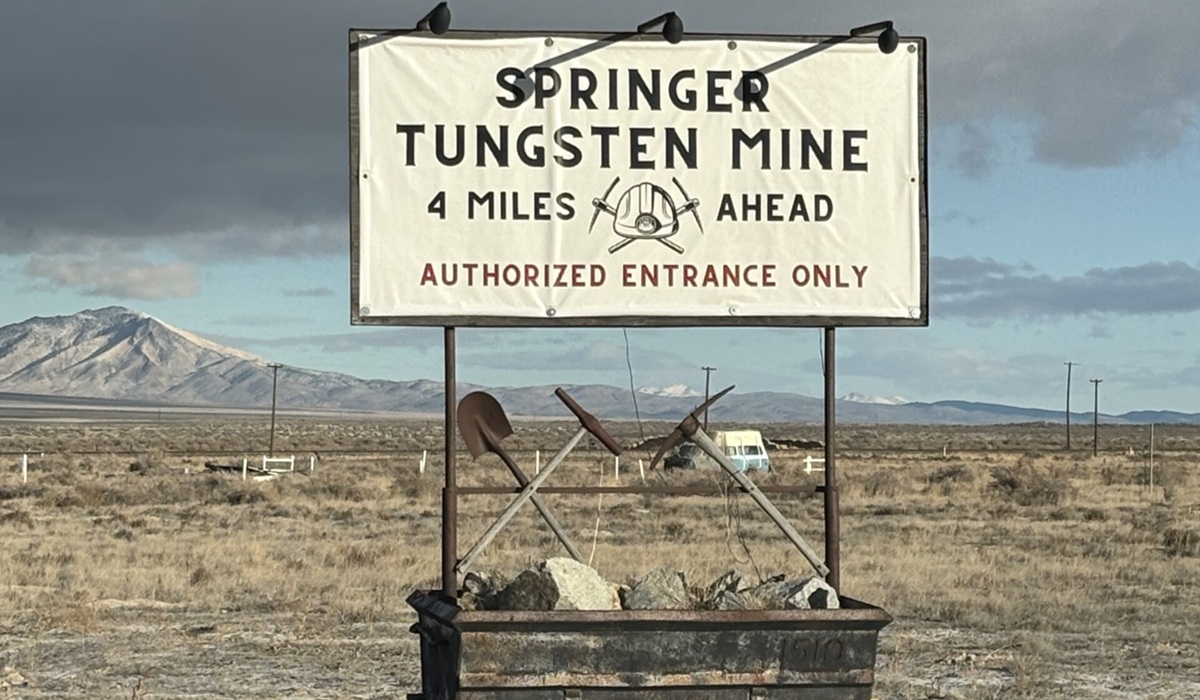
Blue Moon Metals plans to further evaluate X-ray transmission (XRT) sensor-based ore sorting technology after initial tests on tungsten mineralisation from its Springer project in Nevada, USA, delivered positive results.
The Canadian junior said automated particle sorting to pre-concentrate Springer mine output could potentially improve revenue generation and lower project capital costs.
Blue Moon is working on an update of a 2012 preliminary economic assessment on the former mine, near Imlay.
“The program was set up to evaluate the potential for a pre-concentration step prior to mineralised material entering the mill and processing plant at Springer,” the company said.
“The objective of the program was to study the rejection of waste and enhance metal grades, noting that prior to this study, no ore sorting work had been performed on the tungsten mineralization at Springer.
“The tungsten skarn mineralisation at Springer has shown to be amenable to particle ore sorting as a pre-concentration technology that could have a positive impact on project economics.”
Blue Moon said testing and analysis of three composite samples (363kg of low-grade, 339kg of medium-grade and 360kg of high-grade material) saw a 1.3-3.4-times uplift of tungsten trioxide (WO3) grades with metal recovery at 93.3-97.5%.
“Particle ore sorting yields a mass rejection of low and medium-grade material from 25.1% to 71.7% from the three composites, with best results in the medium and low-grade material,” it said.
Testing was conducted at Saskatchewan Research Council in Saskatoon, Canada, using TOMRA commercial-scale XRT machines featuring the Norwegian company’s OBTAIN and CONTAIN AI-driven control software.
“These positive ore sorting results highlight the potential to significantly improve Springer’s economics through pre-concentration of tungsten mineralisation while reducing the risk to the mineral resource from processing lower-grade mineralisation,” said Blue Moon CEO Christian Kargl-Simard.
“Ore sorting means higher tungsten head grades and more tungsten processed per tonne of throughput at the mill, resulting in higher metal production and positively impacting project economics.
“Additional ore sorting and engineering studies for the flowsheet of the process plant are being planned for 2027 as Springer advances toward production.”