Despite major technology advances and massive profits many senior mining technical and operational leaders don’t think the industry is pulling all the levers available to improve stalled productivity and safety markers. That was again a key message to come out of a conference organised by AusIMM, one of the world’s largest mining professional bodies.
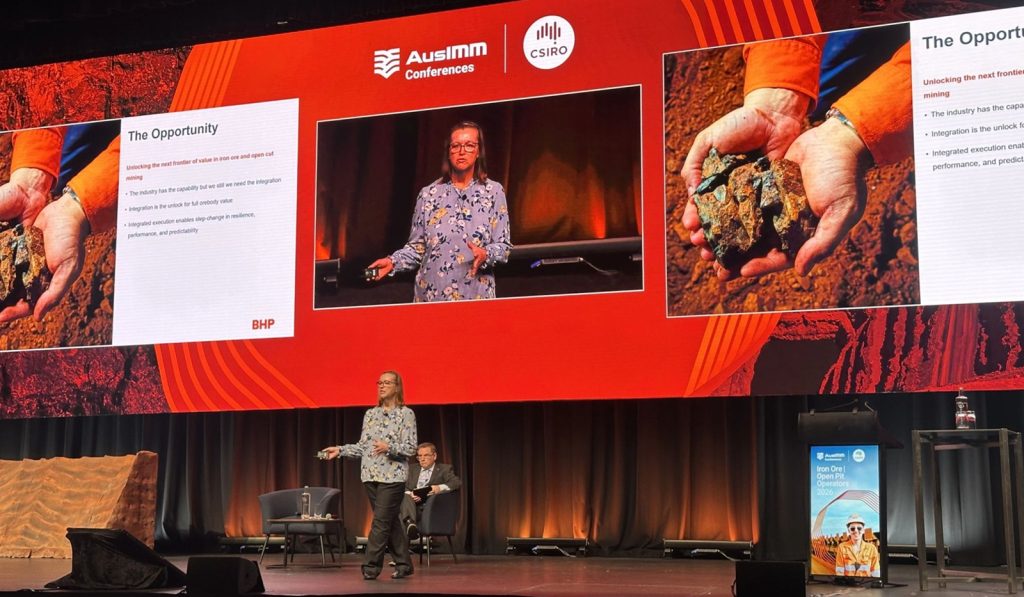
“Meeting the demands of modern mining is going to require us to evolve beyond all the practices and behaviours that have delivered past successes,” BHP head of geoscience excellence, Kerry Turnock, put it succinctly in a stirring keynote at the 2026 Iron Ore and Open Pit Operators Conference (IOOC26).
Iron ore, said Australasian Institute of Mining and Metallurgy CEO Stephen Durkin, was that most venerable of “critical minerals”: “It’s worth remembering the world produces 20 times more iron in the form of steel than all other metals put together.” The World Economic Forum says iron ore makes up more than 90% of all metals mined annually.
Most of these metals continue to be extracted from surface, or openpit, mines even as underground mining is cast as the future of the industry.
The combination of iron ore and surface mining therefore makes the AusIMM event a key international barometer of technical achievement and reflection in the industry. More than 700 people from over 20 countries attended the event in Perth, Western Australia.
What has changed fundamentally in mining this century is the huge step-up in production and material movement rates, primarily to feed China’s takeover of the global steel industry and most other industrial supply chains. Those production levels are now being maintained ahead of what some are calling a new super-cycle. Coupled with the step up in mining rates have been well-documented steps down: deeper surface and underground mines, lower average ore grades; flat to declining productivity and safety despite more monitors, sensors, rules and governance than you could fit in the back of a BelAZ 75710.
“We mine faster than we’ve ever done before,” says Turnock, an internationally respected industry leader who started her career as a geologist at the Paraburdoo iron ore mine in WA in the 1990s.
“I remember when I first started back in my Hamersley Iron days there was a conversation about could we grow the business to 80 million tonnes.
“That’s just one mine [now], not an entire integrated system.
“We mine more than we’ve ever done before. We have greater variability, we have more complex deposits [and] we have tighter margins. We have increasing environmental, social and regulatory pressures that bear down on us. We’ve got more complex geotechnical and hydro environments. We’ve got more data than we’ve ever seen before – my god, we’ve got more data. And the expectations upon us are higher.
“And if we’re honest … we all know that complex environments cannot be managed through fragmented ways of working.
“… The gaps [in] the sequence is where we lose and erode value at scale”
“That’s where many of us find ourselves today.
“In many operations we still structure the work and the systems and the rhythms and behaviours that were designed for a different era.
“The problem is not a lack of expertise. Across the industry we have highly capable geoscientists, mining engineers, geotechs, hydros, processing and closure experts, environmentalists [and] geospatial specialists.
“We do need to get more people into our pipeline [to build future] capability but today we do have capability.
“The problem is that expertise is often deployed in a sequence: it’s deployed in a chain and it’s not deployed in unison and concert together, and that’s where the problem lays because the gaps [in] the sequence is where we lose and erode value at scale.
“Our biggest constraint is [not] a lack of expertise. Our challenge is fragmentation.
“[And] the next step change in performance will not only come from better models, better software and better specialist capability. It’s going to come from better integration. It’s going to come from better integration between disciplines, better integration between planning horizons, better integration between our orebody knowledge and our operations execution and most importantly, better integration of our people.”
Connection, complexity, confidence
The AusIMM conference heard from many leading experts on why that sought-after step up in performance will be hard won.
A 37-year industry veteran with senior operational, technical and consulting roles at more than 50 mines around the world on his CV, who found time to author “Crimes Against Mine Planning” in 2022, Mark Bowater said engineers at the centre of mine value recovery and safety regulation were also at the heart of the industry’s operational systems integration conundrum.
“I’ve been mine planning for 37 years and if I sit back and think about the plans today versus the plans of 37 years ago today’s plans have got way more detail in them and a way better presentation, but at a high level I’m not convinced that we build and execute plans any better today than we did 37 years ago,” Bowater said.
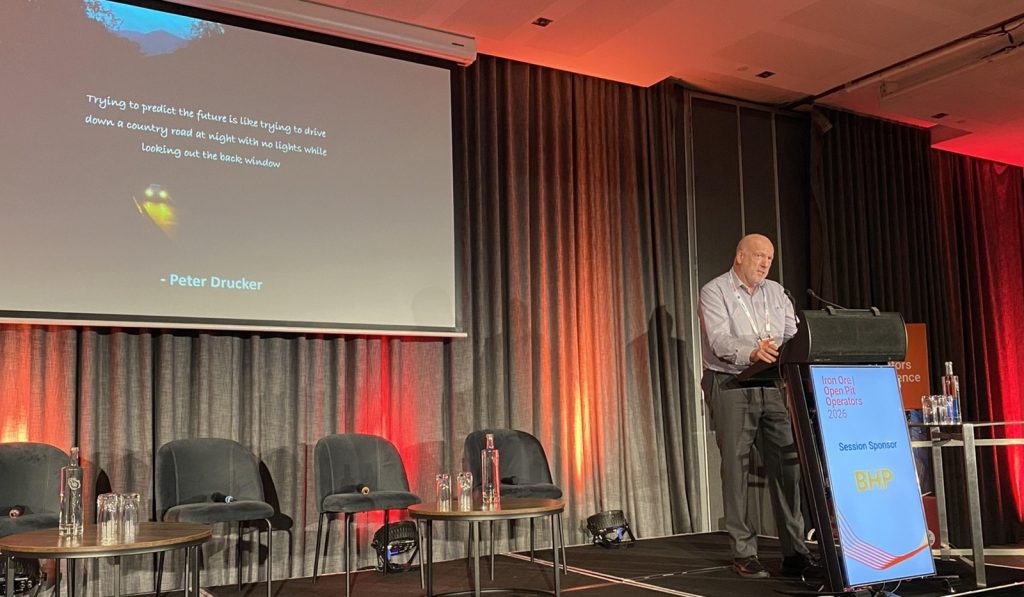
“I don’t think this is a people problem. It’s certainly not a technology problem. I think it’s a system problem.
“Kerry [Turnock] talked about the change in mining in terms of more complex orebodies, more data at our fingertips … I don’t think our mine planning system was designed for today’s challenges.
“We’ve spent decades optimising the components within mine planning without [revisiting] the system itself. [It’s] built over decades and it’s evolved without necessarily being intentionally designed. If I gave you a blank sheet of paper today and said design a mine planning system I don’t know that you’d come up with something with five or six different disconnected time horizons, carried out by different teams at different locations with different objectives [and] different KPIs.
“When I wrote Crimes Against Mine Planning the two biggest crimes out of the 10 that I talked about in that book were optimistic mine plans and … our unwavering faith in deterministic mine planning. As soon as we put something down on paper everyone believes it and it’s going to happen.
“That shot is going to be fired Wednesday next week and that digger will walk in there on Thursday, and it’s all sweet. Since it’s in a plan it’s almost like that’s what’s going to happen.
“But variability happens and we need to be building that variability and that distribution into our inputs, rather than just fix single assumptions.
“It amazes me that things like Monte Carlo simulation were already around before I started in the industry and yet we seem to be happy to run simulations for certain projects but when it comes to business-as-usual mine planning we don’t want anything to do with sort of simulation.
“It’s starting to take hold now. I’m seeing some good tools and some good schedules.
“[But generally] we carry out static plans to artificial time horizons. A week or a month or a year; it’s an artificial time horizon and it’s generally about reporting or some other purpose. We’ve mistaken the calendar for a planning system, which is somewhat of a fundamental design flaw.
“So the mine plan wasn’t really built to fail, it just wasn’t designed for today’s challenges.
‘That’s actually an exciting opportunity because we can redesign it.”
Fragmentation and disaggregated decision-making in mining tends to be reflected in the industry’s major events, such as this one, which hardly ever have the best operational and technical leaders in the same room as corporate chiefs as they highlight their respective upstream and downstream woes.
Bowater, who’s close to finishing a new book, agreed with Turnock that more holistic decision-making was vital if the industry was to achieve a step-change in performance with the geological, capital, human and financial resources at its disposal. Turnock said: “We see in every function that optimises itself without looking across the value chain that we are contributing to a system underperforming.” Bowater said commercial decisions made every day impacted the plans being made and remade around core resources and infrastructure, “and then we’re surprised when our plans are unreliable”.
“My argument is not that we just don’t accept variability but that we actively choose it,” he said, citing three prominent examples of orebody knowledge, asset maintenance and then “fragmentation” itself: blasting rock in a mine.
“The orebody is the fundamental starting point for all of our mine planning.
“We could spend lots of money on exploration and we could know our orebody very well. But exploration is expensive and so we spend the minimum that we think we can get away with to give ourselves enough knowledge or confidence and certainty to plan on.
“The airline industry will operate at 90-to-95% planned maintenance and 5-10% unplanned maintenance. In the mining industry we tend to operate at about 50-50 planned to unplanned maintenance. Parts are expensive so therefore we run them to failure, etc. But that means that our mine planners have no idea when our primary equipment that they’re scheduling is going to break down and how long it’s going to be down.
“And then blasting. We could put lots of explosives into the ground and we could ensure that every shot dug like cream. But again, explosives are expensive. We make a cost decision and we try to put the minimum amount of explosives in the ground [to get] a diggable shot.
“So we introduce variability on top of the inherent variability that we have from weather and all the other non-controllables that exist in the mining industry. And after all of that we think we can produce really good plans that are highly reliable and we should be able to achieve 100% compliance to plan.
“I’m not saying those decisions are wrong. They’re choices that we make.
“But they have consequences.”
Risk and reward
EY’s latest survey of circa-500 mining and metals executives put operational complexity at the top of the industry’s risk watchlist in 2026. It echoed concerns aired for much longer at mining forums like IOOC26 about increasing complexity and operating velocity demanding a fundamental shift in the industry’s approach to integrating mine planning and critical controls.
Alex Atkins, who has been in the industry for 40 years and spent 7.5 of them on ASX mining and contracting company boards, told IOOC26 a couple of hypotheses she was exploring in Curtin University PhD research were being supported by feedback from the many interviews she had conducted. The PhD was examining board assurance of technical and operational critical risk management, including exploration of the “language” gap in what she calls generic, commercially led governance frameworks.
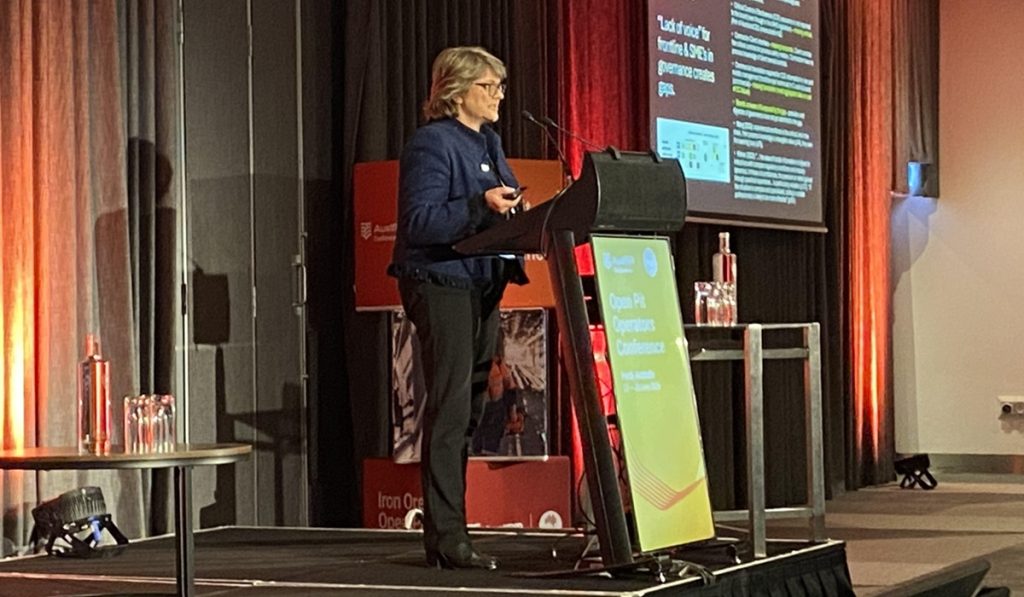
“Mining’s a complex system … and because it’s a complex system it needs to have a plan-to-check learning cycle going on so that as you mine and as an orebody responds to how you mine you can correct how you mine to optimise performance and safety,” she said.
“And then when things go wrong, which they do, because you’re dealing with Mother Nature in a complex system of multivariate interdependencies, the markets hate you and they punish management and the board and everybody gets all reactive.
“If you’re not checking your controls are effective in a critical risk sense and things do go wrong and markets are coming down hard on you, as well as regulators, you’re actually pretty exposed as a director and officer of a mining company.”
Atkins suggested that while this exposure tended to be mitigated by layers of “defence assurance” in commercial areas – finance, legal, IT, ESG – it wasn’t “really done very well for technical and operational risk, particularly in mining”, where it needed to be better informed by industry-specific knowledge. Here, language could be a barrier.
“Everybody here today is either a mining engineer, a geotechnical engineer, a geologist, a metallurgist, or similar,” Atkins said.
“We understand roughly what each other is saying but for people on boards this is gobbledygook.
“They don’t understand what we’re saying. They don’t understand the concepts, the maths, the science. So we’ve got to translate what we know into something they can understand, which is commercial. The simplest version of that is dollars and probabilities.
“We assume our controls are effective, but we don’t know.
“We actually don’t know at the moment, generally speaking, whether we’re operating within our board-approved risk appetite. We have no information that confirms whether our inherent risk is within the risk appetite. This is confirmed from feedback I’m receiving through the surveys and interviews.
“That means we’re operating at our inherent risk, not our residual risk. What is the value at risk? We don’t know that either, because we don’t measure how much it costs when critical controls fail.
“When critical controls fail, what is the cost? That [can have] a long tail. Think about Brumadinho [2019 tailings dam failure in Brazil] and Samarco [Fundao dam failure in 2015] and how much that’s cost BHP.
“They’ve done a lot of work since then to improve their internal audit and technical assurance but, basically, how much does it cost and how can we weave that into board assurance?
“It’s not going to be easy to get that right.
“I have been reading some really interesting things while I’ve been doing the PhD. One is the book by Dan Wang called Breakneck, which talks about the engineering state versus a lawyerly society. It highlights how important engineers are to process safety knowledge [and] critical risk management and critical controls effectiveness assurance that drives a learning cycle where everyone’s learning, not just the front line but right up to the top.
“That’s a very valuable flywheel effect for performance, as much as for safety, that we are currently potentially missing because we’re getting kind of obfuscated by a lawyerly society that we are dominated by, which you see on boards and you see in government and you see it everywhere.
“We’re in our own way.”
Shifting ground
Mining’s data deluge and struggles to attract and hold high-end technical specialists will only accelerate AI adoption, including in crucial pit and ground monitoring and management, according to Marnie Pascoe.
Rio Tinto’s general manager major hazards & environment is a renowned geotechnical engineer with decades of industry experience in senior management and advisory roles.
She said sensors and software were generating vast quantities of data that reflected the increasing depth, complexity and tempo of mining, but “more data can only matter when it changes the quality or the timing of our decision making”.
“The decisions still wait on a human to say yes, it’s good, or no, it’s not; maybe it’s okay or maybe it’s not. What do we need to do to make that safe?
“We’re still stuck with disparate data systems that are challenging to integrate … and we still rely on people’s brains to do a lot of that integration for us.
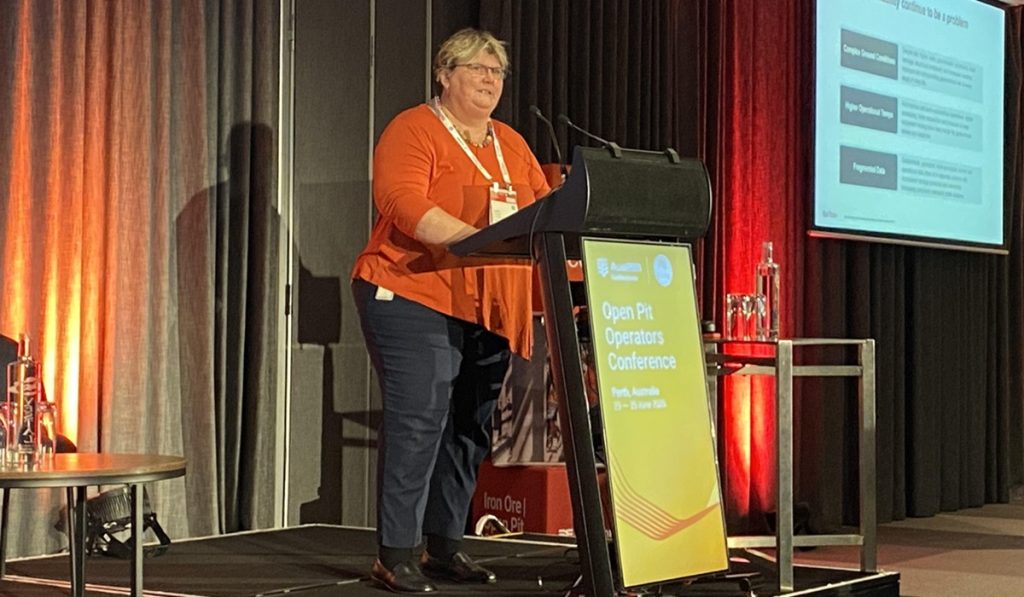
“And the data is often locked up in proprietary systems, so integrating it with another dataset is quite challenging.”
As in other areas, fundamental geotechnical data, “which we base our designs upon” was also “often very scarce”.
“In comparison to the vast amounts of monitoring data we produce the two generic data sources are very, very different,” Pascoe said.
“How do we integrate the whole to derive understanding to enable us to forecast the performance of the future?
“The gap is where AI enters the conversation.
“It can play a role in supporting technical professionals by handling data complexity, accelerating triage and surfacing patterns that may be missed. Digital systems and AI help us overlay large and different datasets quickly and repeatedly, if we code them up correctly, [and] to experiment in novel ways such as juxtaposing different datasets to uncover different insights.
“To get to this faster learning, supported judgment and better decisions we need to take into our context into account. The AI [can] accelerate our risk management loop.”
To get to this point, appropriate assurances must be activated to turn AI output into a trusted tool.
“We must have governed systems and apply the same rigour we apply to all other data and systems that we use. So data quality validation and operating envelope definition are absolutely required. The assurance elements become the foundation of trust,” Pascoe said.
“A high confidence wrong answer is one of the most dangerous products that this digital system can generate.”
Pascoe said if geotechnical roles did move to the “higher-value judgment end of the circle [and] if we automate all of the junior work, we’re not going to have any senior professionals” and this was where the industry collectively had to demonstrate foresight.
“I think this is a key thing for us all to think about as senior professionals judging by the amount of grey hair, me included, around the room,” she said.
“People still need to learn the basics and need to be out looking at rocks. It’s fundamental to what we do.
“If we lose sight of that and lose sight of the skills that we need to do that then we can’t rely on the system that’s supporting that.”
Was the core human resource and training need going to be something non-technical industry leaders bought into?
Pascoe said: “Communicating with senior leaders who are not involved in the day-to-day work is always a challenge. I don’t think I’ve got a silver bullet.
“Some things work, some things don’t and you’ve just got to evolve.
“But I can tell you one thing, doing the same thing over and over and expecting a different result doesn’t work.
“If you’re finding it’s not working, try something else.”