Most new Australian mines rely on imported plant, equipment and capital to move forward. In future they might wait on vital international skills and expertise, too, according to an economic security and defence policy analyst.
“Australia needs to make a choice: build a national critical minerals workforce or rely on foreign talent that is in short supply,” says David Saultry, a former adviser to the prime minister and Department of Foreign Affairs and Trade.
“The country needs to nurture its own geologists and engineers who can run its mines and processing facilities, ensuring these sites are strategic capabilities instead of stranded assets.”
The recent 27th World Mining Congress in Peru heard international competition for available engineers, geoscientists, metallurgists and, increasingly, automation and other technology experts, was set to intensify.
“Talent development should be treated as critical infrastructure for the future of mining,” said the CEO of Canada’s NORCAT, Pejman Salehi.
The event heard an estimated 200,000 new mining workers would be needed in Canada alone by 2035, with industry leaders stressing the importance of more purposeful collaboration between miners, academia, entrepreneurs and government.
“This is as fundamental to the future of our industry as trying to build a medical system without doctors and nurses to actually work within that system,” Stephen Durkin, CEO of the Australasian Institute of Mining and Metallurgy (AusIMM) said at another mining event in Perth, Western Australia.
Durkin, describing declining domestic mining professional capacity in Australia as a “massive industry threat”.
“We hear from government that we’re a rich industry [and] you should be able to solve this yourself. We don’t see it as a problem,” he said at GRX26. “And the industry will be able to get them [professionals] from overseas because Australia is a great place to work and we pay a lot of money.
“But if we extend the medical analogy, if we didn’t have homegrown doctors and nurses we wouldn’t have the medical capability we need to support and sustain that industry.
“That’s the easy out, for us to rely on talented people coming from overseas. There were over 10,000 mining engineers that graduated from Chinese universities last year. There were 91 mining engineers graduated in Australia last year. So there’s the answer – we get them all from China.
“But we lose that world-class capability that we have in Australia, that’s currently deeply admired the world over. Retaining that capability I reckon is in our national interest.”
Writing for the Australian Strategic Policy Institute, Saultry said while China’s now prolific mining education institutions were producing graduates to meet its growing needs, traditional centres of excellence had declined.
“If Australia is hoping its partners can fill [the] workforce gap it will be waiting a long time,” he said.
“Its key ally and driver of critical minerals security, the United States, graduated only 162 mining engineers in 2023. Canada and India face similar constraints.
“Even if another country could step in, building a strategic capability without the people to operate it simply transfers the vulnerability. Critical-minerals security requires building a reinforcing system, not just racing to break ground on mines.”
Saultry used a different analogy, saying buying nuclear-powered submarines under the AUKUS banner without the necessary engineers and operators would deliver Australia “a lethal platform that never leaves the port”.
“Mines and processing facilities without the geologists and engineers to run them are stranded assets, not strategic capabilities,” he said.
Saultry repeated a common refrain about a growing disconnect between mining and communities, even in countries such as Australia with a significant economic reliance on the industry.
“The problem is perception,” he said.
“Abstract government strategies and industry statements about integrated supply chains do not change Australian students’ career aspirations. The critical minerals agenda needs to be grounded in practical outcomes that speak to young people’s priorities, such as clean energy. Two-thirds of young Australians support the energy transition but less than half understand that clean energy requires mined resources.
“That link should be taught by embedding critical minerals literacy into the curriculum at the high school and university levels, and it should be delivered by trusted academic champions. Clean energy advocates need to include the base components in their narrative, not only the final technology. This approach counters the commercial incentive inherent in industry messaging, making the case credible and reaching students before they make career choices.”
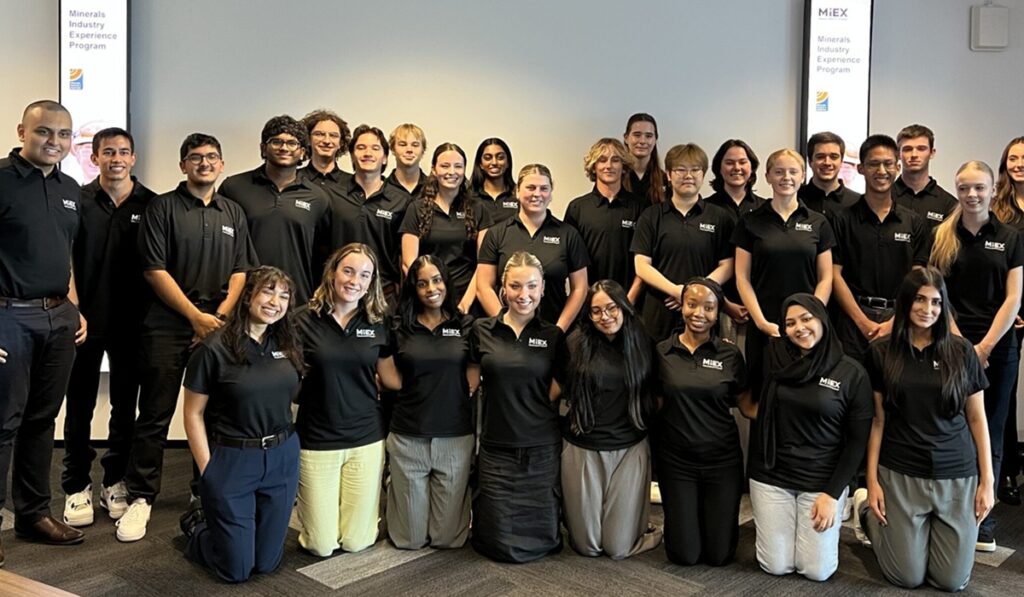
Saultry said while nearly half of young Australians did not know what opportunities existed in mining, programs such as the Minerals Industry Experience (MiEX) program piloted by the Minerals Council of Australia last year showed promise and should be expanded.
The MiEX program grew out of a BHP initiative aimed at first-year STEM (science, technology, engineering and mathematics) university students – giving them a period of paid first-hand industry experience and exposure. BHP joined fellow mining majors Rio Tinto and Glencore, through the Minerals Council, to expand the program and it has since grown beyond Australia.
Minerals Council of Australia deputy CEO Sid Marris said at the GRX26 forum in Perth the first MiEX had 500 applications for 70 positions, underlining an appetite to at least explore the industry among students who otherwise wouldn’t be exposed to it. “At the end of the experience 22% of participants changed their majors to a mining-related major,” Marris said.
“It just shows that when students are given exposure to mining the interest is there,” said Glencore Australia human resources manager, Stella De Best.
“They go into university not knowing what mining is about. The reality is most people haven’t been to a mine site so their understanding of the mining industry is often shaped by assumption rather than experience.
“This is where it’s really important that investing earlier matters and the MiEX program has allowed us to engage with students before they’ve locked in a major or ruled out the sector entirely.
“If we want a bigger, more diverse, more future-ready [talent] pipeline we cannot wait until career choices are already made. We need to do this in advance.”
A model has been created and is seen to be working and now the Minerals Council of Australia and similar organisations in Canada and other parts of the world are looking at how they can significantly grow MiEX.
Saultry said shifting perceptions and building programs such as MiEX would no doubt take time to translate into increased enrolments.
“Until then the government must provide financial support to university geology departments facing closure,” he said.
“This may be expensive, but there is no point spending $1.2 billion on a strategic [mineral] reserve without nurturing the personnel needed to run it.
“When Macquarie University and the University of Newcastle closed their earth science departments in 2021 they lost institutional capacity that will take investment and decades to rebuild.
“Adelaide University’s recent closure of its mining engineering program only compounds this.
“Australia has some of the world’s largest critical mineral reserves. These, combined with the country’s universities and training infrastructure, make it the natural hub for delivering quality education on domestic and allied critical minerals industries and producing a top workforce.
“But these pathways must be designed carefully and it must be built now.
“If successful, Australia could become the principal supplier of critical minerals talent – capturing revenue, generating research and securing the strategic value of owning the pipeline, not just the resource.”