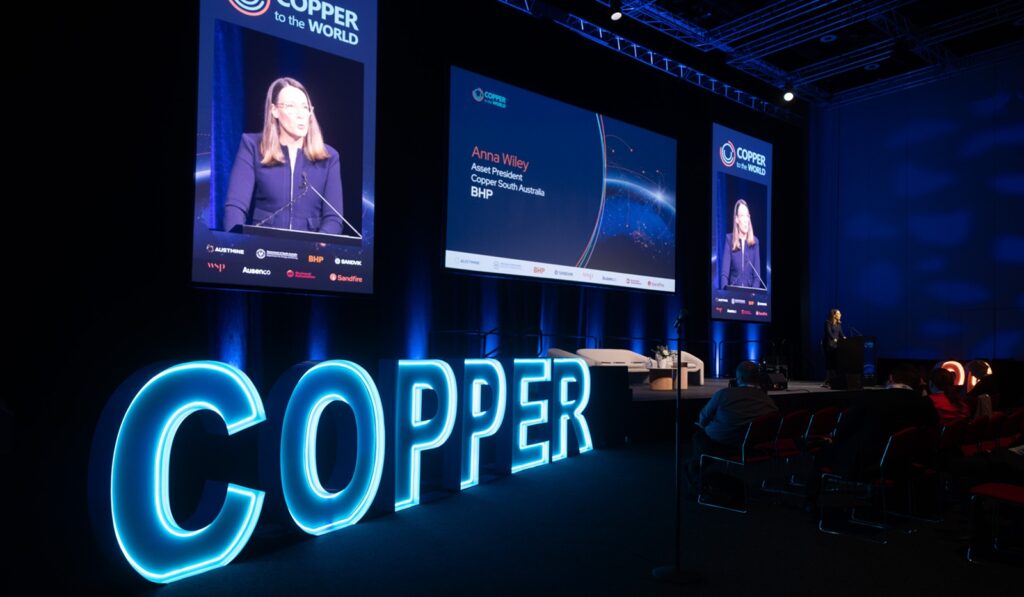
Momentum has shifted in the US$400 billion global copper market and certainly in South Australia, which wants a much bigger slice of the pie and hosted this week’s Copper to the World conference in Adelaide.
“It’s a big change from last year to this year,” said Katie Hulmes, one of many BHP business leaders at the event.
“The copper price is obviously underpinning a lot of that … but definitely the vibe has shifted since last year and I’m pretty excited about what’s to come.”
A circa-50% lift in the copper price over the past 12 months undoubtedly affected the mood in Adelaide, where officials from conference co-host, the SA government, were ebullient about planned BHP and wider investment in copper growth and in major infrastructure such as the proposed A$5 billion Northern Water project. Former Queensland public servant and now SA Department for Energy and Mining CEO Paul Martyn compared the proposed venture to Queensland government rail spending in the 1960s and 70s to open up vast coking coal riches in the state’s Bowen Basin. “This is nation-building infrastructure,” he said. “It is clear that this government is 100% behind the mining industry and 100% behind the copper opportunity. The state of SA is putting its balance sheet on the line … to unlock opportunities for the industry.”
It’s a calculated bet aimed at converting more of the state’s geology – SA is said to have two-thirds of Australia’s known copper resources – into gigawatts and gigabytes the world needs.
“The electrification demands of the global economy are going to double in the next five years and we all know that without copper that just simply can’t happen,” CRU senior analyst Piers Montgomery said at the conference. “Make no mistake we are very much already in a battle for copper units.
“There is also a battle between superpowers for AI hegemony and there’s a lot at stake in that.”
Copper to the World heard SA’s copper income, underpinned by BHP production at Olympic Dam, Carrapateena and Prominent Hill, rose to $5.3 billion in the year to June 30. BHP Copper South Australia asset president Anna Wiley described a pathway to doubling last year’s 321,000 tonnes of copper production as “achievable”. She cited external modelling that had the $5.7 billion of annual economic value being generated by Copper SA – 3% of gross state product – growing to more than $9 billion a year post the proposed expansion.
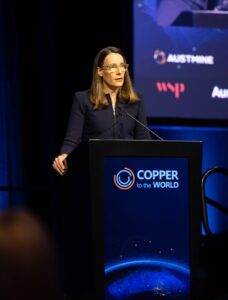 Wiley said the estimated additional average $3.6 billion a year of GSP “would deliver the same economic uplift as holding [the annual Australian Football League] Gather Round every fortnight for the next 50 years”.
“We’ve all seen what AFL Gather Round has done for SA in recent years – the buzz, the excitement and the economic impact has been phenomenal,” she said.
“Copper is already a pillar of the SA economy. Our growth agenda will take this to a new level.”
SA’s minister for energy and mining and state treasurer, Tom Koutsantonis, told forum delegates the geopolitical dimensions of the BHP plan, along with the growth ambitions of companies such as Sandfire Resources and Kantra Copper (ex-Hillgrove Resources), were potentially immense.
“Our copper sector is determined to play its part in meeting the world’s growing demand for copper,” he said.
“It’s our state’s top export item, reaching $5.3 billion last financial year. But we know that’s in the rear-vision mirror now and greater opportunities lie ahead.
“Copper sits at the centre of cleaner transport, electric vehicles, power transmission networks, digital infrastructure supporting data centres, defence capabilities, renewable energy technologies [and] advanced manufacturing. Copper is the modern economy and that’s why the demand curve is so clear.
“Copper is at the heart of the government’s economic strategies not just because of electrification but because of the complexity it brings to our economy. Complexity brings jobs. Complexity improves wages. Complexity in the economy improves living standards. Complexity is what every ambitious first-world economy strives to have in its mix.
“Australia’s largest company announced for the first time last year that copper had overtaken iron ore as the largest source of global revenue [and earnings]. South Australia is identified as a major future growth area. The Big Australian is now a copper miner not an iron ore miner.
“We’ll look back at this moment when that flipped.”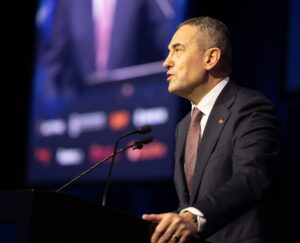
Koutsantonis (pictured right) said while geology (including the gold, uranium, silver and other credits attached to copper revenue streams), regulatory framework, workforce and transport infrastructure were tailwinds for BHP and the state’s copper growth momentum, “water is the gap”.
BHP reportedly draws more than 30 million litres of water a day from underground groundwater sources. It faces a situation with social perceptions and expectations around natural resource use not dissimilar to what the world’s biggest copper producers in Chile have confronted. BHP’s SA expansion hopes rest on new water supply.
“South Australia is the driest state in the driest country in the world,” Koutsantonis said.
“We will be investing billions of dollars into water that no South Australian will ever drink”
“Northern Water is a desalination project that is focused on sourcing water to effectively drought-proof the mining sector in the Gawler Craton. It will have dramatic implications for the South Australian budget and for South Australian community.
“We will be investing billions of dollars into water that no South Australian will ever drink and we’ll be using our scarce resources as taxpayers to help unlock what we think will be the greatest opportunity that this state has ever had.”
SA’s copper spotlight is naturally on BHP but Brett Beatty, managing director Australia of Resource Capital Funds, said this could be a double-edged sword. He told the forum SA needed to do a better job of selling itself to the broader investment community.
“BHP is a big beast. It’s more than just Olympic Dam,” he said.
“But they have an obligation to help that narrative as well. They can’t soak up all the resources and make it harder for everyone else and then say, this is the greatest place to invest in copper right now.
“I don’t think investors, speaking as a generalisation, would put South Australia, let alone Australia to be honest, up there in terms of places to invest in copper and I think that’s just an education process.
“I’ve always been really impressed with the mining infrastructure here in South Australia. We’ve just got to find a way to leverage it.
“And one thing in your favour is you’re not competing with a whole bunch of other commodities. I’m from Western Australia and copper is the fifth, sixth or seventh commodity down the list. There is real potential here to make copper a true focus for the state.”
CRU’s Montgomery said a potential $5.6 billion expansion of Olympic Dam copper smelting and refining capacity, if green lit by BHP at the end of next year, would underline the economic attractiveness of the state. “We’re not seeing that in other jurisdictions outside of strategic nationalism,” he said. “There has to be room to leverage that.
“I think South Australia, in many ways, is at the vanguard as a template for [new copper investment]. People quite naturally talk about their own project, but they talk about a region. That sort of district-level development is what could define this era of [copper] supply.”
Brendan Harris, CEO of $10.5 billion copper mid-cap Sandfire Resources, said he had long believed in the prospectivity and investment credentials of the state where he grew up and studied geology and geophysics at Flinders University, in the south of Adelaide.
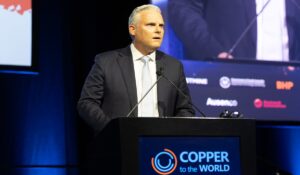
“It’s fantastic to be back in town as South Australia is becoming Sandfire’s next frontier of its future growth given the opportunity we see to develop a truly world-class copper production hub in the Curnamona Province with our local partner Havilah Resources,” Harris said.
Sandfire, which has seen its market value climb an impressive 250% in the past five years, produced about 154,000t of copper in FY2026 from its current operating hubs on Spain’s famed Iberian Belt and Botswana’s Kalahari Copper Belt. It signed a deal with Havilah late last year to earn 80% of the Kalkaroo copper project in the Curnamona and ramp up regional exploration on Havilah-held ground. Kalkaroo has circa-1.1 million tonnes of copper and 3.1 million ounces of gold in resources outlined to date.
“New supplies are becoming increasingly difficult to develop given often complex permitting regimes and the sheer capital intensity of large-scale developments,” said Harris, who spent nearly 13 years at South32 and BHP before joining Sandfire.
“Not to mention the often remote and challenging locations major players have and are moving into in Africa and South America, all of which introduces a different and often underappreciated level of execution risk for financiers and shareholders alike.
“Suffice to say there is a major prize on offer for those governments and industry participants who can attract capital and successfully discover, develop and operate the next generation of copper mines quickly, efficiently and sustainably.
“We now have access to US$1 billion of liquidity, given our strong net cash position.
“Good orebodies make good management, as they say. We believe South Australia, the Curnamona province and the Kalkaroo copper-gold project specifically have all of these elements, which is why we’re moving so quickly to grow our presence in the state.
“We’ve already established an 80-person camp on location and commenced a planned 130km drilling program, which I think will grow. That will be the cornerstone of the prefeasibility study we have underway and is expected to be completed in FY28.
“This year alone we plan to invest US$50 million at Kalkaroo, where ultimate success could lead to a multi-billion-dollar investment in a large, long-life, low-cost operation, opening up South Australia’s next copper production hub.”