Debate about where heavy vehicle autonomy in mining has got to and how it progresses continues to rage. Rio Tinto’s Mark Arkell says people are the crucial lever for pulling maximum value from machines interacting more continuously with rocks. Mariana Minerals director Willem van Schalkwyk sees “a completely different paradigm of planning for machines versus planning for human operations” being key. “That is something that we’re spending a lot of time thinking about.”
Mining engineer Arkell and mechatronic engineer van Schalkwyk sat together at a recent Dyno Nobel investor day discussion panel in New York, USA. Their paths to the stage couldn’t be more disparate.
Zimbabwean-born Arkell, mine and ore delivery system general manager at Rio’s Iron Ore Company of Canada (IOC) operations in Newfoundland and Labrador, spent the early part of his career in Western Australia’s Pilbara region. “I spent a lot of time on the manual side of the mining game and then technology came in, especially in extreme environments like the Pilbara. It’s 40-45C [there] and now where I am it’s minus-40C. We need to challenge ourselves to remove people from those types of conditions. That’s why automation is really important.”
van Schalkwyk got his mechatronics degree at Stellenbosch University in South Africa and spent nearly nine years at McKinsey, rising to associate partner, before joining Mariana’s mission to reinvent mining.
The company calls itself a “software-first” miner, with a proprietary operating system and core focus on “end-to-end” autonomy at its sites defining its business. Rio is very much in the traditional orebody-first mould, though it’s been a consistent dabbler in proprietary tech.
Yet Arkell and van Schalkwyk, senior company leaders in what is in many ways a new era for mining, seem to agree on many things.
“Being able to secure labour for new projects in new jurisdictions, where there’s not an established skilled labour force … is a really big challenge,” van Schalkwyk said before calling out the need for people with the skills and mindset to plan differently for mines of the future, around machines and zero-entry rather than continuing to build mines that put people in inherently hazardous situations.
Arkell, with his experiences to date, can see the enormous potential of that new world.
“We focus a lot on people learning mining and on people operating but I don’t know if we’ve focused enough on people learning the systems and how to be both a miner but also a good system operator.
“Those are two areas we need to really focus on.”
With autonomous machines and fleets, “instead of managing separate parts of the mining operation you become manager of a system”.
“As an operator, instead of firefighting, you become calm and you can now work on optimising the system. Whereas without automation you do become quite reactive.
“[From a safety standpoint] it’s just amazing the incidents that are [avoided in current] autonomous operations.”
More startlingly, without automation, “you would never have seen those incidents”.
“You’re in like a false sense of security,” Arkell said.
“With autonomous you see what’s happening and then [also] what it’s preventing.”

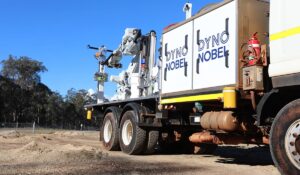
van Schalkwyk said end-to-end mine autonomy needed a range of “edge-case” solutions to become a reality. Mariana is working with Dyno Nobel to advance one of them: autonomous blast loading and monitoring.
“Until you’re able to fully automate those [edge cases] you’re not able to get to the place where you can change your safety factor and change your design and get to a point where you can like unlock all the value from truly zero-entry mining,” he said.
“Once we get to that point do we think we can really start scaling.”
Autonomy and AI converging
McKinsey & Co says technology improvements have led to declines in mining injuries over the past 15 years (more like 30 years) but it highlights the fact that fatality rates are no longer falling. It says agentic AI tools shape as productivity and safety improvement drivers for the industry.
In a new op-ed it says autonomy, edge computing, remote operating centres and digital twins are vital safety and productivity levers.
“Generative AI and agentic AI systems enhance and may even redefine these levers,” McKinsey says.
“Gen AI copilots in control centres summarise safety data, identify root causes of near misses and draft incident reports in seconds.
“Although human intervention and monitoring is always required, agentic AI systems that can act autonomously within predefined safety parameters are beginning to orchestrate preventive responses, from adjusting ventilation to rerouting autonomous vehicles around unstable ground.
“Miners are experimenting with large language model–based hazard and incident analytics that can analyse thousands of hazard reports, near-miss narratives and investigation summaries to identify recurring precursors – such as disabling or overriding alarms or contractor interface breakdowns – and propose targeted monitoring questions for future supervisors that could avoid incidents.”
McKinsey says these approaches “have the potential” to remove structural barriers to faster change and it suggests “intelligent safety” could become a foundation of competitive advantage in mining.
“Safety technology and operational excellence are converging into a single, data-driven ecosystem,” it says.
“Combining automation with AI-powered safety platforms and appropriate human oversight can contribute to improved performance and worker safety, reducing unplanned downtime, improving asset utilisation and protecting workers.
“The result is mines that are not only safer, but also more productive, efficient and sustainable.”
AI and mining a winning combination: Barrick CEO
Global gold major Barrick Mining Corp has picked California’s Avathon as a strategic partner to “connect data, operational knowledge and AI intelligence” across its business.
“Avathon’s Physical AI will give Barrick the ability to continuously analyse conditions, identify risks and opportunities, support decisions and enable action across critical mining operations,” Avathon said.
Barrick CEO Mark Hill says AI can potentially change “how a mining company safely operates at its core”.
“Our ambition is to connect the entire value chain, from exploration through production, unlocking the full potential of our people to make better decisions, more safely,” Hill says.
“By combining world-class mining expertise with AI, we can improve safety, increase recovery and productivity, strengthen reliability and supply chain performance and create a more resilient and disciplined operating model.”
CEO of 13-year-old Avathon, Pervinder Johar, believes Barrick is taking a “fundamentally different approach” to its peers.
“This is the evolution from digital mining to an AI-native mining company, where human expertise and physical AI work together across the entire value chain to drive safer operations, higher productivity, greater recovery and stronger returns,” he said.
The pitch
Having tucked away a US$4 million pre-seed funding round earlier this year, Tex Software is trying to woo a senior engineer to join the founders in San Francisco. CEO Federico Chavez-Torres says the 10-month-old start-up, which has built a new “market intelligence platform” and database for heavy equipment users, has done some hard yards “building the data layer and proving the business works”.
“It is live, it covers most of the country and it is generating revenue,” Chavez-Torres says.
“Demand has outrun what we can currently serve so the question is no longer whether this works it is how fast we can build on what we have.”
Job ads signal the hard yards still to come.
Like a lot of start-ups, and you’d have to say particularly ones looking for software engineers in California, a real growth headwind is finding the right people at the right time. In a global tech hub, at a time when governments around the world are trumpeting their strategic minerals needs, Tex Software’s messaging seizes the current zeitgeist.
“The small rocks of our streets and in our buildings were once big rocks,” Chavez-Torres (we think) says. “Concrete and asphalt does not pour itself. Rare earth minerals do not magically bubble up to our surface anymore and data centres are not a naturally occurring phenomenon. Everything you interact with requires heavy equipment.
“And yet dealing with these assets is painful and sucks. Projects get stalled, contractors go out of business and we and everyone else in the supply chain all suffer for it. It’s not a problem that can necessarily be abstracted away.
“It requires intense technical execution as it does [go-to-market] and creativity.
“This is a massive market and we are creating a disgustingly lucrative opportunity inside of it.”
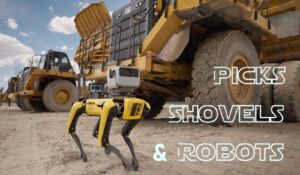
About Picks, Shovels & Robots: “When everybody is digging for gold it’s good to be in the pick and shovel business”. In the 1800s thousands rushed to California – and other parts of the world – to find gold. Most miners went broke or didn’t survive. Merchants who sold shovels, pans, denim pants and staples made a fortune. Some of the technology has changed but suppliers of essential prospecting and mining tools and services have never been more in vogue.