Silicon Valley-backed US miner Mariana Minerals is working with mine explosives major Dyno Nobel on autonomous blast preparation technology Dyno says can significantly improve in-pit productivity and safety.
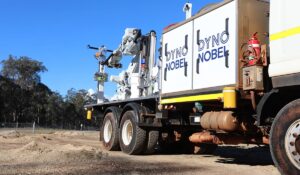
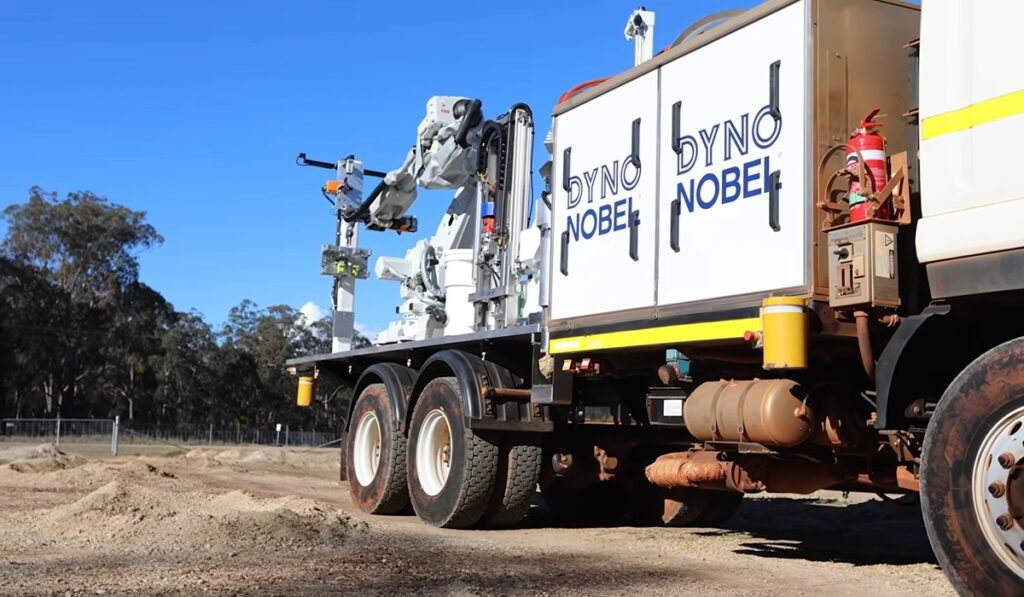
Unveiled publicly by ASX-listed Dyno Nobel at its recent Investor Day in New York, USA, the “world-first” end-to-end autonomous blast-hole inspection and loading technology is seen to have potential to help open up stranded and satellite mineral deposits as well as enhance the economics of existing operations.
Mariana is trialling Dyno Nobel’s equipment at its Copper One copper mine, aka the former Lisbon Valley operation, in Utah.
“Our goal at Copper One is end-to-end mining and processing autonomy and blasting sits right at the start of that chain,” Mariana chief technology officer and co-founder Juan Lozano said.
“We’re deploying this technology with Dyno Nobel and developing the MineOS integrations that carry it through to the rest of the autonomous operations.”
MineOS is a Mariana-developed operating platform.
Dyno Nobel group technology officer Dirk Van Soelen said in New York after five years of research and development mine-bench autonomous blasting was “no longer a concept”.
“Dyno Nobel has built actual [explosive loading] units, which have been trialled in controlled environments,” van Soelen said.
“These units will soon be deployed to our first trial site here in the USA with our customer and partner Mariana Minerals who is … building one of the first fully autonomous mining operations in the United States.
“They are the right partner to move this technology forward with us.
“Our objective is reliable autonomous loading which integrates with the mine systems and other autonomous solutions that the customers have already deployed at their sites.
“Through a staged pathway between now and mid-2027 the new system will autonomously measure, prime, load, stem and record each hole accurately to the design parameters, thereby automating the full cycle without people on the bench, resulting in repeatable efficiencies and predictable results.
“This new technology improves safety and downstream efficiencies but it also unlocks other opportunities like access to high-risk ground, greater night shift utilisation, continuous operations and zero-entry mining.
“Even fully operational mines have areas that have been difficult to mine due to safety risks or unstable conditions like underground voids and yet until now there has not been an autonomous solution available for the total drill and blast process.”
Dyno Nobel is using a mine bench carrier developed by Australian electro-robotics firm Jevons Robotics, which recently reported a “world-first” of its own with automated loading of packaged pre-split explosives at gold major Newmont’s Boddington mine in Western Australia.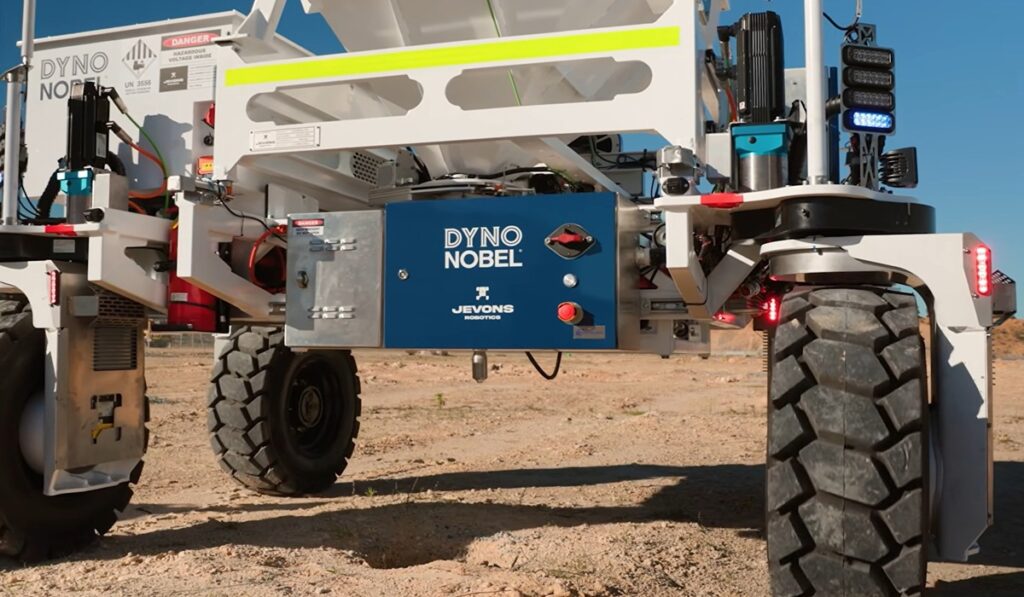
Jevons said its battery-electric ARTEV1000 pre-split system could eliminate mine highwall exposure for people typically manually handling explosives. Its one-tonne modular platform, automating blast-hole location, packaged explosive deployment and in-hole retention, could also be used in automated hole-dipping and blast-hole quality-assurance to maintain high equipment utilisation across drill-and-blast cycles.
Boddington was the first global deployment of the robot.
Jevons Robotics CEO and founder Todd Peate said Newmont joined Dyno Nobel, Orica and “other global mining companies” as customers.
He said Jevons’ robotic platform could be configured for various uses.