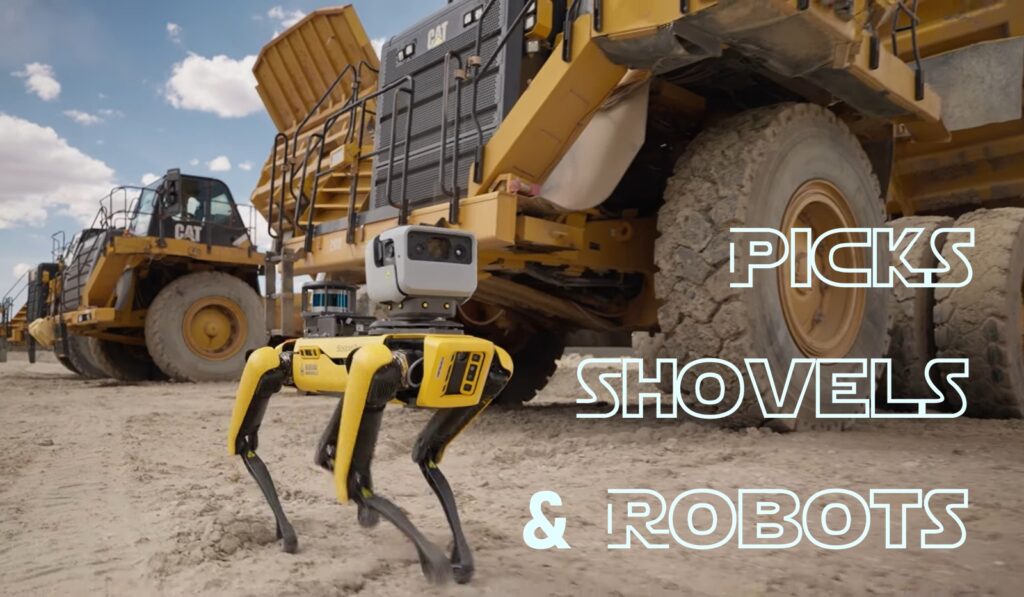
What’s changed in the mining and metals technology funding space? Plenty, as encapsulated in the image below. This week Euro-American venture capital firm OVNI Capital and Palo Alto-based Gigascale Capital hosted a “From ore to orbit” investor event in downtown San Francisco as part of Andreessen Horowitz’s (a16z) Tech Week. OVNI general partner Augustin Sayer said the Silicon Valley Bank Experience Center’s capacity was tested.
“What a turnout for our critical minerals event for Tech Week,” said Sayer, a panel moderator on the night. “Six hundred registrations from all corners of the world and an attendance that pushed the limits of SVB Experience Center.”
OVNI, which has French mineral discovery tech start-up Lithosquare in its current investment portfolio, wanted to zero in on the “strategic chokepoint of modern industrial supply chains”: critical minerals.
“The companies that can extract, process and refine them at scale will shape the next decade of AI infrastructure, energy systems and national security,” the firm said in its promo.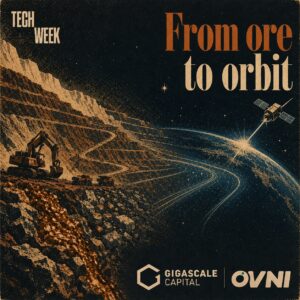
OVNI partner Emily Eisenblatter said the aim was to bring together “founders, operators and investors who care about the physical constraints behind the next wave of technology” for “From Ore To Orbit”. The event subtext was, not surprisingly, about America re-asserting its primacy in the race for terrestrial and off-Earth technological superiority, a race that can’t be won – on Earth at least – without the metal-making supply lines the country shipped off to China over decades.
Three panels examined midstream mineral processing, connecting capital and commercial, game-changing technology more intelligently, and finding the right language for better communication between tech start-ups and a mining industry used to working in splendid isolation.
Delian Asparouhov was happy to kick things off on the back of Varda Space Industries’ circa-$600 million series D equity raise. Varda, co-founded by Asparouhov, is on a mission to manufacture medicine (for starters) in space. Asparouhov is also a partner at Peter Thiel-backed Founders Fund, a VC with an interesting way of framing its investment focus.
“Not all technology is created equal,” it says. “There is a difference between Pong and the Concorde or, less glibly, between Intel and Pets.com. Microprocessing represents real technological development, peddling pet food on-line, less so.
“The best companies create their own sectors.”
Shining characteristics of such companies, from a Founders Fund perspective, included lack of popularity – “popular investments tend to be pricey” – and complexity. “They are difficult to assess,” the firm says (which contributes to their lack of popularity).
“They have technology risk but not insurmountable technology risk [and] if they succeed their technology will be extraordinarily valuable.”
Cue the likes of Lithosquare, KoBold Metals, Solcoa Industries, Magrathea, Durin, Red Metals and Atana Elements at the OVNI-Gigascale event.
“Many of the technologies for separating, refining, smelting and metallisation were invented here [in the USA] but were scaled and optimised outside the country,” said Evaline Tsai, a partner at Gigascale, an investment firm founded by ex-Meta CTO Mike Schroepfer that announced a new US$250 million fund to back start-ups in June. It has Red Metals, Skouria and Solcoa in its portfolio.
“Reclaiming the midstream will take more than breakthrough technology.
“It will take a more honest look at technical risk and more creative ways to finance the long road from lab to industrial scale.”
Tsai moderated a panel with Magrathea founder Alex Grant, Solcoa founder Hooman Reza Nezhad, Clareo’s Wiles Kase and Prelude Ventures’ Juan Pablo Soulier looking at a “new playbook” for rebuilding US leadership in critical minerals.
Tsai said taking on science and engineering risk, not one or the other, were more frequently part of this playbook. “Promising science is only the start,” she said.
“Turning a reaction into a commercially viable process that runs reliably, cleanly and cheaply at scale is a whole second round of innovation.
“The panel agreed that teams that break through work on both, having one inform the other.
“I’ve seen this firsthand with Hooman and the Solcoa team who went from grams of metal in a lab to tonnes of production in two years by solving the chemistry and the engineering side by side.”
The “right capital stack” was another key topic. Forum attendees heard venture equity was often the only option early when speed mattered and a technology was still being de-risked.
“As companies mature debt and project financing become increasingly viable tools to fund growth without relying exclusively on dilution,” Tsai said.
She said government support for the sector was a topic of debate, but “capital intensity is not”.
“The panel didn’t agree on whether government funding is essential to building a successful critical minerals business.
“But everyone did agree that financing a $100 million facility is very different from financing a $1 billion one and that the capital available at each stage shapes what gets built.”
Brendan Mathews, a Virginia-based investor and managing partner at Kauffman Fellows, said the combined science-and-engineering-risk recipe takeaway was “the whole deep-tech funding problem in one sentence”.
“Venture equity being the only option early is exactly the trap,” he said.
“It’s priced for binary outcomes not for de-risking a process that runs 24/7.
“The winners find the boring capital before they need the exciting kind.”
A Colorado-based adviser to VC firms, Quoc Pham, observed that a big reason US rare earth production was moved offshore in the early 1990s was the sector’s “waste‑handling burdens”.
“One issue I rarely hear discussed in rare‑earth reshoring efforts — but that deserves early attention — is waste management, including hazardous and radioactive waste,” he said.
“The technology itself wasn’t the bottleneck.
“Rebuilding domestic capacity means understanding why those facilities became unattractive and pairing that insight with thoughtful, sustainable modernisation.”
Another panel moderator, Earthshot Ventures general partner Matt Logan, gave an interesting take from a self-described “climate tech” VC.
“People sometimes ask us whether critical minerals really belong in a climate thesis,” he said.
“We think they’re the foundation of one.
“If we’re excited about investing in solar and storage – and we are – we have to be honest about where their materials come from.
“We’d rather help build mines better than pretend we don’t need them.
“Within a decade the world is on track to come up 25% short on mined copper, according to the International Energy Agency.
“Every tonne we don’t find and refine will slow the energy transition and the data centre buildout. Other metals like lithium, nickel, and cobalt also face significant shortfalls, accumulating to a multi-trillion-dollar supply gap.
“Meanwhile new discoveries have slowed to a trickle: only 5% of the copper deposits found over the past 35 years turned up in the last decade.
“The easy ones near the surface are already tapped. For an industry slow to adopt new technology that’s a massive opportunity. Start-ups can find what’s left faster and mine it more cheaply, with a smaller environmental footprint.
“Think lithium extraction without evaporation ponds or refining that includes recycled scrap.”
Kase, engagement leader at US advisory firm Clareo, underlined the need to find new ways to produce minerals and metals that could not come from “the conventional model” of mining in the timeframes being posited by governments and forecasters.
Copper, for example: a 30% supply shortfall by 2035 estimated by the likes of the IEA wouldn’t be impacted by major new mines (as existing large-scale mines continued to see average head grades decline and material movement rates climb). Kase and Clareo founder Peter Bryant observed in, “No New Large Mines”, the largest new copper project in the US, Rio Tinto and BHP-owned Resolution in Arizona, entered a federal environmental review process in 2013 and got a Record of Decision in March this year.
Nickel and lithium price collapses closed Western operations while predominantly Chinese state-backed capacity scaled.
Kase said the future was already playing out. Taseko Mines harvested first cathode from the Florence in-situ recovery (ISR) operation in Arizona this year.
“Direct lithium extraction recovers lithium in hours where evaporation ponds take 12-to-18 months,” he said.
“Century [Zinc] in Queensland reprocesses zinc tailings at a scale that places it among the top 15 global zinc producers.
“The provocation is deliberate.
“A future with no new large mines has to be built on purpose.”
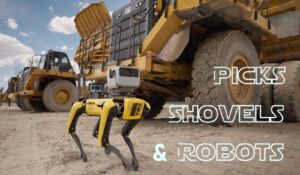
About Picks, Shovels & Robots: “When everybody is digging for gold it’s good to be in the pick and shovel business”. In the 1800s thousands rushed to California – and other parts of the world – to find gold. Most miners went broke or didn’t survive. Merchants who sold shovels, pans, denim pants and staples made a fortune. Some of the technology has changed but suppliers of essential prospecting and mining tools and services have never been more in vogue.