ABB CEO Morten Wierod says a new joint venture with Japan’s Mitsubishi Electric in the Asia-Pacific region will add to the growth momentum the company is seeing in its electrification business, the standout in its September-quarter results.
“This deal will make us the low voltage market leader in Japan, one of the world’s largest electrification markets, allowing us to benefit from the broad electric power trends including any local data centre build-out,” Wierod said of the proposed Mitsubishi Electric business carve-out to be 51% owned by ABB.
“The Mitsubishi Electric business to be contributed to the JV generated around US$640 million in revenues in its fiscal year 2025, with a low double-digit EBITDA margin. We expect the joint venture to improve to at least a 20% operational EBITA margin within five years.
“We see long-term returns well above cost of capital.”
The JV follows the $5.5 billion acquisition of English process equipment and technology company, Rotork, ABB announced in July.
The Swiss group reported 21% year-on-year growth in Q3 electrification revenues to $5.42 billion, while orders climbed 70% yoy to $7.67 billion and the division’s backlog grew 83% yoy to more than $16 billion.
ABB’s motion business saw 11% yoy growth in sales to $2.32 billion while automation was 6% higher at $2.12 billion.
“In the industrial space data centre order growth was exceptional and growing at a triple-digit pace,” Wierod said.
“Strong improvement was recorded in the utilities segment with grid investment need remaining tangible as aging assets require upgrades to not only mitigate outage risks, but to also meet accelerating power demands.
“In the energy-related business orders were up in the oil and gas segment and activity increased among nuclear customers.
“Mining orders remained broadly stable although initial signs of increasing customer activity for capex spend were noted.”
ABB’s revenues for the first nine months of 2026 rose by 15% yoy to $27.91 billion – “an all-time-high” – while its order backlog grew 35% in the period to $32.3 billion.
Fortescue sees Toowong commercial path
Australian iron ore major Fortescue says low-arsenic copper produced at a Brisbane demonstration plant using its Toowong Process shows technology it has been developing for four years could have commercial prospects.
The company said an initial 40-tonne batch of cleaned copper concentrate with less than 0.25% arsenic had been produced from feedstocks containing up to 7% of the contaminant.
“This product has now been sold, demonstrating that the Toowong Process can produce marketable, commercially competitive copper concentrate from high-arsenic feedstocks,” Fortescue said.
“Across seven campaigns and more than 3000 hours, the Toowong Process reduced arsenic levels in concentrates to below 0.3% while also retaining more than 99.9% of the copper.”
Fortescue says its patented process, acquired in 2022, uses a low-temperature, low-pressure hydrometallurgical method to separate arsenic from copper concentrate.
“Technology and innovation are central to Fortescue’s future growth,” Fortescue growth and energy CEO Gus Pichot said.
“This technology has the potential to make high-arsenic deposits more economically viable, addressing major processing challenges and eliminating emissions at the same time.
“The world needs more copper to build renewable energy projects and expand electricity networks and Fortescue’s innovations will be key to unlocking the resources that can meet that demand.
“This is a technology that Fortescue will consider using itself as we explore copper deposits globally. It could also be hugely important for the industry and our peers more broadly as well.”
Pichot said Fortescue was continuing to optimise the Toowong Process and advance its commercial engineering, with a focus on further reducing capital and operating costs. This included testing concentrate produced from Fortescue’s Canariaco copper project in Peru.
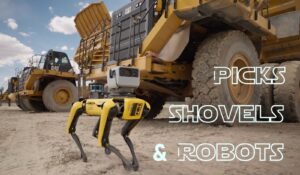
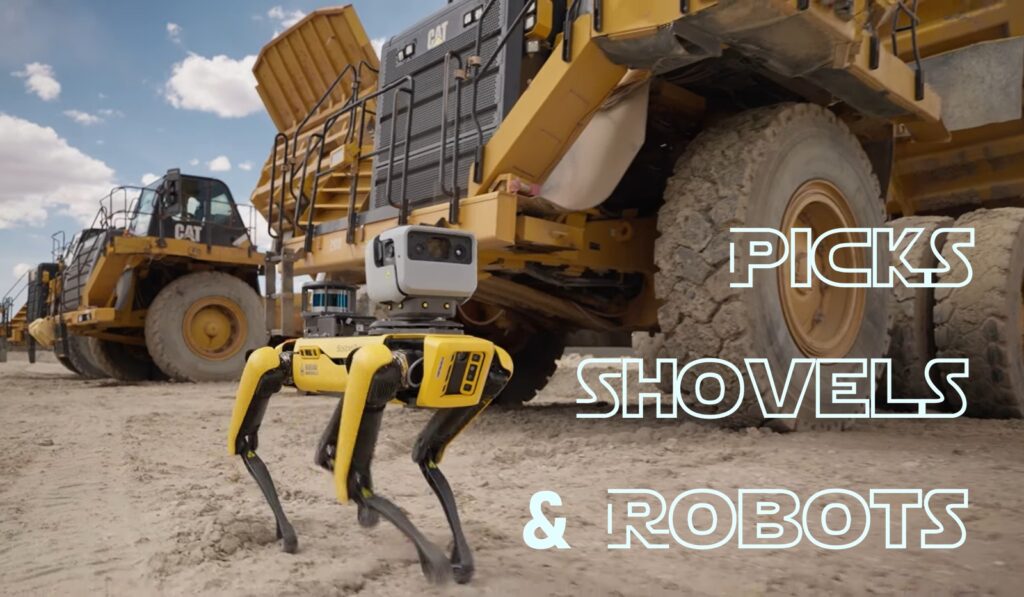
About Picks, Shovels & Robots: “When everybody is digging for gold it’s good to be in the pick and shovel business”. In the 1800s thousands rushed to California – and other parts of the world – to find gold. Most miners went broke or didn’t survive. Merchants who sold shovels, pans, denim pants and staples made a fortune. Some of the technology has changed but suppliers of essential prospecting and mining tools and services have never been more in vogue.