The Mining Forum Americas 2026 in Colorado Springs heard a lot about gold, copper, geopolitics, permitting, capital allocation and, of course, scaling artificial intelligence. “We’re all experiencing what’s possible with AI,” said McKinsey & Co’s Richard Sellschop. But a race for real competitive advantage has barely begun.
More than 200 miners, developers, explorers and royalty-cos presented at the latest forum. Many more attended. McKinsey’s latest survey of 19 miners, among 100 international business leaders it canvassed on AI, indicated they were all “using AI somewhere in their business”.
Most respondents reported their personal productivity and that of many of their peers was getting an AI boost.
“But only 6% say they’re actually seeing bottom-line impact at a level that would move the needle,” McKinsey senior partner Sean Buckley said.
More intriguing perhaps is the McKinsey view that AI could be delivering 10-20% EBITDA uplifts within a few years, based on “successful end-to-end” process transformations and driven by throughput, recovery and asset uptime gains. Supporting a shift, McKinsey says 15 of the 19 big miners it tracks reported a financial impact from AI in the third quarter this year versus four only a quarter earlier.
“They’re actually putting real resources behind it,” said Buckley, citing a report reference to “10 of the biggest miners” building large digital and analytics teams representing 2-3% of organisation headcounts.
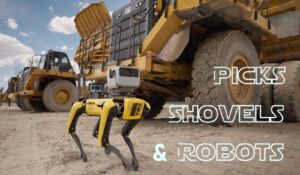
“And if we look forward and we think what’s coming next it’s physical AI,” he said.
“We’ve gotten a taste of it in terms of autonomous [machinery], which is the most advanced and furthest adopted [new technology] in mining. It’s staggering to think that autonomous deployment has increased by five-times over the last couple of years.”
The surge was being led by China, “whereas Canada and Australia were furthest ahead two or three years ago”, Buckley said.
“The rate of innovation in mining now in China is really something quite remarkable,” Microsoft energy industry adviser, Akilan Kapilan, said at the forum. “When we look at autonomous vehicles, 5G deployment, electric vehicles in mining [and] many other dimensions, there’s a real uptick in China.”
While Buckley suggested some Western companies were “going all in” on AI and digital-led examination of economic leverage points – “companies are trying to completely rethink a business domain” – the forum heard most industry initiatives were emergent.
Ravi Malladi, copper major Freeport-McMoRan’s senior data and AI adviser, said seeing “monetisable value” in AI roadmaps was “the challenge that everybody is trying to solve for”.
“It is no longer a technology problem to solve, it is how can technology help to solve a process problem and a governance issue that goes with it,” he said.
“Technology is of no value unless you are able to actually move the needle on process adherence.
“You can take an oil sample [but] if the oil sample doesn’t make it to the lab and the data doesn’t get into your system, which is your foundational system of records, I’m afraid AI is not able to move the needle very much.
“So it’s a combination of people, process, technology … [something] we keep talking about.”
McKinsey partner in Chile, Ferran Pujol, said: “A pile of AI initiatives is not a transformation.
“The test is whether the domain runs differently, not if we have better tools.
“Ten of the 19 companies [in McKinsey’s mining survey pool] claim they have a P&L impact from AI in processing. They have models that trace the ore characteristics from the block model to the processing plant. They have models that define the optimal blending and models that define the optimal set points. The most advanced companies are moving towards a closed loop. That means in that particular domain they are connecting the AI to the control systems, and the operator goes from defining the set points to monitoring the models and the production.
“In procurement we’re seeing a Cambrian explosion of agents … that support buyers in negotiation and in finding levers to reduce cost. For example, [Peru’s] Minsur has agents that send emails directly to suppliers of smaller contracts to negotiate directly. At [Chilean miner] SQM they use agents to improve the productivity of suppliers.”
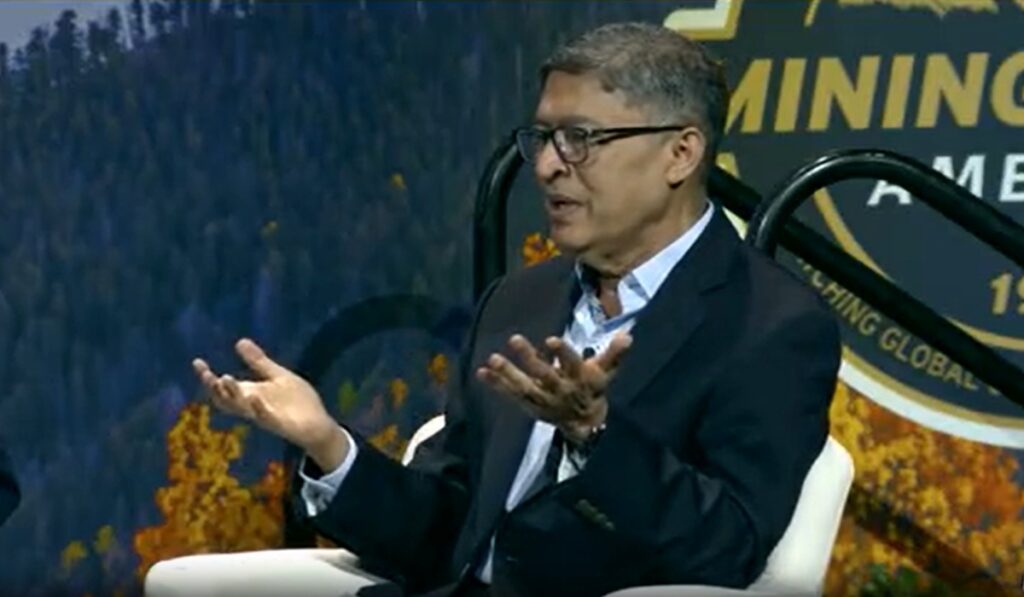
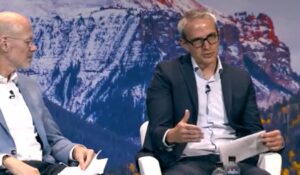 Pujol (left) said predictive maintenance was the AI application use-case most talked about in mining, but meaningful impact so far was mainly being recorded in maintenance planning and shutdown optimisation. Similarly, in mine planning and operations “there’s lots of innovation and lots of things being tried but they are only seeing impact from digital twins”.
Kapilan said mining’s much-talked-about technical and managerial siloes remained a significant adoption barrier, as was traditional operational distrust of new technology.
“The gap between operations and technology is where a lot of the AI in mining dies,” he said.
“One of the solutions for that is selecting a single owner … that has one line of budget.
“That helps connect to the P&L and close that gap between operations and technology.”
And “co-creating with the frontline is one of the absolute musts when you really want to move from pilots to scale”, according to Malladi.
“Embed the tech teams with the frontline,” he said.
“I think there is always the corporate-versus-site-type dynamic … in many mining companies.
“So find an operating model to embed the tech resources who are doing the stuff that we are talking about at the rock face, if you will, to the extent possible. I think that is going to move the needle a lot more rapidly than other paradigms.
“And stay away from solving a siloed issue.
“Look at the end-to-end workflow. Maintenance, for example, is condition identification, planning, scheduling [and] execution: think through a solution across the value chain and you have much better chance of moving the needle versus a siloed solution.”