US “software-first” miner Mariana Minerals’ Silicon Valley backers have poured US$310 million into its coffers, giving it a shot at significantly expanding copper production in Utah and pursuing extraction of lithium from oil and gas wastewater in Texas.
Khosla Ventures led the series B funding round, which takes Mariana’s capital raised so far to about $400 million since it was founded in 2024. Khosla founder Vinod Khosla thinks Mariana CEO Turner Caldwell, a Stanford mechanical engineer who spent more than nine years at Tesla, “is the kind of operator who can actually build and run AI-driven mines and refineries, faster and cleaner than anyone thought possible”.
Khosla, the Sun Microsystems co-founder who created a $15 billion fund manager, says critical minerals “are the materials that decide whether America builds its own future or keeps depending on China to build it instead”.
“The minerals are there. What’s been missing is the will and the AI to run mining and refining autonomously. That’s exactly what Turner’s team is building and why we backed them from day one,” Khosla said.
Mariana has restarted a copper mine (with a refinery) in Utah’s San Juan County. It has ambitious plans to produce 50,000 tonnes of copper per annum at what it calls Copper One, sooner rather than later, while it zeroes in on commercial lithium production in the first half of 2027. It describes Lithium One as its “first step towards building a new major player in the lithium industry”.
Mariana is working with the likes of Sandvik and Pronto on fleet automation in Utah. Pronto is part of (ex-Uber boss) Travis Kalanick’s Atoms, which has just snagged $1.7 billion of equity funding from Andreessen Horowitz/a16z. a16z is named among investors in Mariana’s series B raise, along with Breakthrough Energy Ventures, BHP Ventures, Mitsubishi Corporation, In-Q-Tel (IQT) and others.
The “software first” in Mariana’s blueprint refers to its MarianaOS and other operating platforms. It says MarianaOS “compresses traditional five-to-10-year project execution timelines by roughly half and reduces commissioning timelines well below industry benchmarks” but has not been around long enough to demonstrate this.
“Our goal by the end of the year is to have no humans in the [Utah] mining operation,” Caldwell said in a CNBC interview.
“Right now we have hybrid autonomy where there is still a handful of vehicles that are manned.
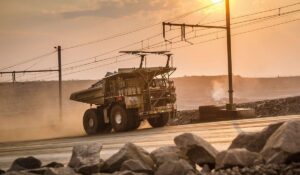
“What we’ve generally seen in the last 10 years is that haul truck autonomy has started to become a thing. But humans still orchestrate those autonomous assets. What that means is a haul truck can navigate from A to B when a human tells it where A and B are.
“Where we are focused is both autonomy on the hardware side, generally in partnership with folks who are developing the autonomy stack around the equipment, but also a lot of focus on the autonomy in the decision-making layer – in the orchestration layer. So instead of humans sitting in between multiple autonomy platforms we use reinforcement learning to control those autonomous assets.
“It’s obviously a massively operationally intensive industry and one of the biggest challenges the industry has faced in the last 10 years and more acutely in the last five is that the labour pool attrition has been pretty dramatic. And so we don’t really think of it as marginal cost improvement. We’re trying to solve a binary problem, which is one where by reducing the headcount per unit of metal produced you’re bringing mines and refineries on line that might not have [progressed] when they were headcount intensive.
“A lot of people see autonomy as jobs disappearing. The reality is when you deploy it at sites that wouldn’t have been cost competitive to operate at all you’re actually increasing the headcount. It’s just a different class of jobs. There’s going to be lot more focus on maintaining autonomous systems, on the telemetry and the networking, to ensure you’ve got good connectivity and data capture is robust. And we are doing a lot of that workforce development that will enable these assets to operate and be cost effective.”
Copper selling for more than $14,000/tonne and lithium carbonate at a nominal $20,000/t-plus are clear tailwinds for Mariana and incentives for targeting brownfield production.
Caldwell says the company aims to “go as fast as possible … and expand the pipeline”.
“The ambition is to go and chase as many critical minerals as we can bring to market,” he said.
“The plan is 10 mines in 10 years; 10 mines and refineries. We’re starting with lithium and copper but we’re going to be diversifying into uranium, rare earths, nickel, cobalt, manganese, magnesium … and doing as much of that domestically as we can before expanding overseas.
“We’re starting out with smaller assets the major incumbents aren’t really looking at because the way they have reduced costs for the last few decades has been though scale.
“And we’re trying to break that scale dependency with autonomy. And if you break away from having to deploy $5 billion or $10 billion capex you can bring a whole bunch of assets online that would not have been cost-effective to bring online without a major focus on reducing operating costs.”
Where did he see Mariana in a competitive landscape dominated by companies that had been in the game for decades?
“I think there is room for everybody.
“What’s really interesting about the point in time we’re in right now is that we are at this inflection point where the global economy is getting pulled into an operating mode which is much more metal intensive.
“There’s going to be a lot of winners in the space there is no doubt about that and it’s one of the most exciting times to be building in this space because of all the demand signals.
“It used to just be the electrification story that was driving this. When I spent time on this [material sourcing] at Tesla it was energy storage and EVs and the broader electrification trend. Now it’s that plus AI infrastructure, plus robotics, plus defence, plus reindustrialisation that is pushing the demand forecasts to a whole new gear.”