Policy manoeuvring signalling the “biggest US policy led shock to the world economy since the 1970s” would likely result in further delays to critical mineral project delivery worldwide without disrupting China’s dominance of key metal supply chains, a 2025 mining and metals outlook webinar has heard.
The Fitch Solutions BMI webcast pointed to potential domestic fast-tracking of a “robust critical mineral project pipeline” in the US under new president Donald Trump’s Agenda 47 manifesto, but a four-year window and America’s legal morass – not to mention unfavourable current price signals for most metals – put a big question mark next to Trump’s ability to prime this pump.
Meanwhile, BMI analysts say Trump’s aggressive tariff strategy threatens to “fracture critical mineral alliances and trigger a cascade of retaliatory measures globally”.
“While China has traditionally been the focus of protectionist policies within the critical mineral sector, Trump’s latest actions are now targeting countries that have previously enjoyed free trade agreements with the US that were specifically designed to foster critical minerals trade and a lot of these partnerships were formed under Biden to foster production and strengthen critical minerals supply chains,” said BMI metals and mining analyst Amelia Haines
“And they’re now at threat.”
Haines highlighted the Mineral Security Partnership, launched in 2022, which united 14 states and the EU to diversify and expand critical mineral supply chains.
“This coalition engages resource rich governments, offering comprehensive support to advance critical mineral projects across all stages of the value chain,” she said.
The coalition also brought heavyweight government backing, and assurances for private sponsorship of projects, to the table. These mechanisms for facilitating project financing, some in high-risk jurisdictions, are currently up in the air.
“We also expect to see a tightening of legislation surrounding foreign ownership of critical mineral projects alongside these trade measures, with countries introducing a more robust framework for reviewing investments as this sort of era of protectionism ramps up,” Haines said.
She said while initiatives such as the MSP were themselves a form of protectionism Trump’s policy steps “could amplify these protectionist measures and … completely reshape existing policies into a far more aggressive framework”.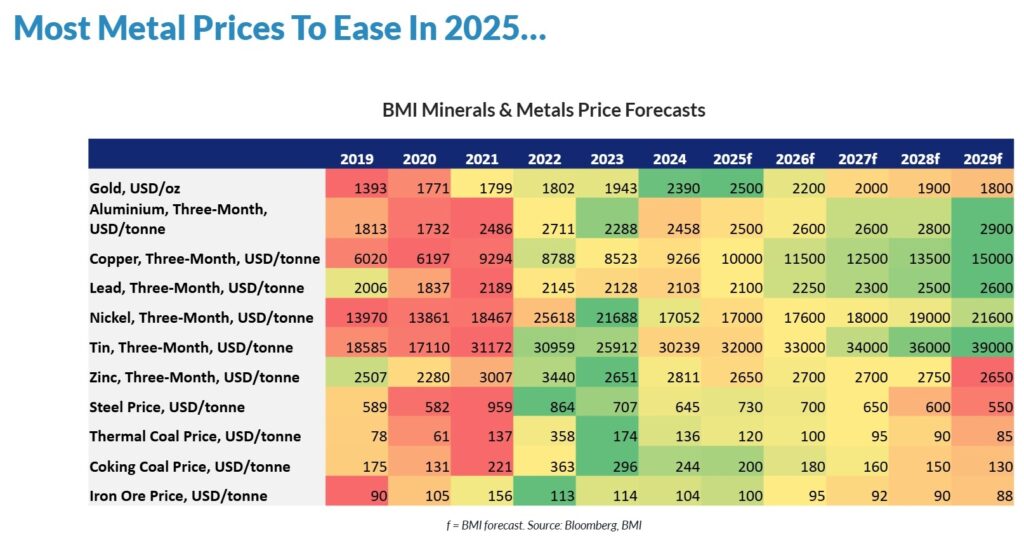
Haines said rising resource nationalism in resource-rich countries further complicated the critical minerals new primary supply picture.
“We expect resource nationalism to gain momentum, with a particular focus on value chain integration … in critical mineral rich markets,” she said. “Resource nationalism occurs when governments of mineral rich countries exert control over domestic natural reserves to maximise economic or political gains. This control can be exercised through a range of policies, including but not limited to export taxes, bans, local content requirements and nationalisation. Resource nationalism is expected to remain prominent in South America and Sub Saharan Africa, continuing the trend that we’ve seen over recent years.
“There is a robust pipeline of critical mineral projects globally which is crucial for meeting growing demand in the coming years. Though many of these projects are located in relatively stable states a significant number are in markets that are risky and have potential to disrupt or halt projects altogether, which presents a risk to future critical mineral production.”
BMI head of commodities analysis Sabrin Chowdhury said for both industrial and precious metals price direction for 2025 would be determined “much by sentiment, which will depend significantly on the macroeconomic outlook”.
“Tariffs and trade tensions are likely to severely impact our growth forecasts for the economies involved and global growth as well, in turn impacting metals demand from end use industries,” she said. “A serious escalation in trade tensions is highly likely. But even if just the current measures last for a few months this would be the biggest US policy led shock to the world economy since the 1970s.”
Meanwhile, China continues dominate global supply of 26 of 50 US-classified critical minerals.
“China is the world’s largest producer as well as consumer of metals,” said Chowdhury.
“China has always been and continues to be a major risk generator for metal markets globally.
“The mainland Chinese economy continues to face a number of downside risks. Most importantly to metals is its real estate sector’s financial difficulties. We believe that the housing market downturn in mainland China will last years and this will weigh on metals demand, although growth in non-property sectors will attempt to offset losses to a certain extent.
“Our country risk team forecasts Chinese economic expansion will slow to 4.5% this year compared to 5% last year, with risks slated to the downside, and this offers little hope for a strong rebound.
“Ater four straight months of expansion China’s manufacturing PMI contracted again in January.
“We expect that Chinese policy makers will announce more aggressive measures to support the economy following key political meetings that will happen in March.
“In aggregate, the impact of a 10% tariff for now on the Chinese economy will probably be quite small and could be counterbalanced by further stimulus measures.”
BMI also says while successful lithium and copper exploration has added a significant number of new projects to its global mines database an inability to advance projects quickly will accelerate M&A in the critical minerals arena.
Senior metals and mining analyst Olga Savina said Rio Tinto’s $6.7 billion acquisition of Arcadium Lithium was expected to “further reinforce the critical minerals M&A wave” even as a prolonged decline in lithium prices continued.
“This price landscape has created favourable conditions for a wave of M&A in the industry,” she said, adding
Strong deal values reflected “confidence and optimism in the long-term prospects” for the sector.