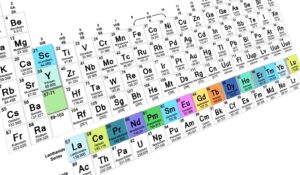
The news anchor said it sounded like something out of science fiction. Atomic Tessellator founder and CEO Alain Richardt kind of agreed: “We say this material doesn’t exist anywhere else except in this room. It is completely novel. And then we show all of the data sheets and the testing and it suddenly brings it right into the real world.”
Richardt’s New Zealand start-up is getting lots of attention. US prime defence contractors, the CIA, Google, London and NZ VCs are all taking more than a little interest. Richardt recently returned from a visit to the White House and says he could be back there in a few weeks.
Speaking at NZ VC GD1’s biennial Believe Bigger event in Auckland, the former Google software engineer said Atomic Tessellator’s atomic-scale models and simulations of synthetic substitutes for some rare earths and other materials were garnering predictable attention at a time when governments were looking for ways to unblock critical supply chains. In-Q-Tel, a US VC with links to the CIA, Crane Venture Partners, New Zealand’s Icehouse Ventures, Outset Ventures and GD1 backed Atomic Tessellator’s US$8.1 million April seed funding round. Australia’s Salus Ventures and Side Stage Ventures, and IBM business Confluent, are other supporters.
Google even expanded its Australian Startup Accelerator program across the Tasman for the first time this year, “inspired by two incredible Kiwi startups”. Readers can guess the name of one of them.

“They [investors and clients] recognise that this is a problem that is at the national security level,” Richardt said in Auckland.
“Most people when they worry about RE materials are still thinking about opening a mine. They don’t even know that substitution like this is possible. It is something that we’ve made possible.
“Because our models are based on raw physics we are able to study and attempt to replace everything. It doesn’t always work; it’s not a silver bullet. But what we’re able to do is come as close as we can to the performance of real materials. We’ve got two flagship materials that we’ve discovered in the last year … and the pace of increase has been crazy.
“Our first generation material took us four or five months to make. Then it was down to two months, then it was down to weeks and now it is just one week. So we can be given a material that’s under a geopolitical constraint, we scale our computations up, we run our simulations that tell us how it performs in the real world and then we have a candidate material in the lab in a week.
“When we finally get to the lab instead of having single-digit success percentages like most other material science companies we have an … 80% success rate with this synthesis.
“We are doing quantum physics. We use a huge amount of computation. But it’s all relative to what you’re delivering and … then also, what are the alternatives. One of the things we’re happy to get across when we’re explaining the company to people is that it only costs maybe $100,000 or $200,000 to find a suitable replacement for a rare earth. We can do that now in just one week. And that’s comparable to a billion dollars and five years opening a mine.”
Richardt said Google’s support had been two-tiered: technical and financial in the form of cloud computing credits.
“At the time we had raised US$1 million,” he said. “And they gave us about $0.5 million in credit. At one stage our US intelligence partner gave us a material that they wanted the US off [foreign dependence] and we were able to scale up to 200 GPUs and find an alternative material. That was our first one we found in a week.
“We wouldn’t have been able to do that without the enormous support of Google’s computing credit.
“Just a few weeks ago we were in the White House presenting this to some very senior people in US critical materials and we met with the Department of Energy and [the House Select Committee’s] Critical Minerals Policy Working Group. We’ve already got solutions for them, just in the last few weeks, and I’m going back in three weeks to present them to them.”
Resetting the clocks
Attacking mineral and metal delivery bottlenecks from the other end of the value chain is US-based AiMinr, whose founder this month said plans by the country to enforce a ban on Chinese-origin defence materials at the start of 2027 seemed fanciful.
Dr Ari Rostami said not just US but broader new supply of essential refined rare earths and other metals could take decades, a time horizon that simply didn’t align with national security and wider industry policy timelines. “These are two different clocks that don’t really reconcile,” he said.
While China’s centrally coordinated industrial development had fundamentally recast the global mineral and metal supply map this century, Western projects continued to move through fragmented and largely sequential development processes. As well as misaligned raw material flows and downstream industry builds, the grinding processes risked technological redundancy.
Rostami, a mining engineer who founded AiMinr this year but has worked on the firm’s flagship software for five years, has said for a while slow public sanctioning of new mines was only part of the problem.
“Mines are built on studies and studies are slow, expensive and produced by teams [geology, engineering, hydrology, metallurgy and financial modelling] working in separate tools,” he says.
“Decisions worth billions rest on a handful of scenarios because there isn’t time to run more.
“Any changes in the baseline of one of the [different] disciplines’ assumptions will equate to redoing weeks and maybe sometimes years of work from scratch.
“This is not a geology problem. It’s actually not a regulatory problem. It’s a problem with the process in which we validate these assets on the engineering side.”
Artificial intelligence offered solutions if its output could be trusted. A Maptek conference in Western Australia this week heard about the importance of “glass-box AI” in building trust in the technology while opening communication lines between siloed professionals to aid better, faster decision making. Rostami similarly says AiMinr’s multi-agent mining capital project orchestration platform was “AI without the black box”.
AiMinr used multi-disciplinary agents to automate elements of planning, scheduling, cost estimation and process-flow design, potentially compressing months of work into weeks. It separated its AI orchestration layer from an underlying calculation engine. “We are not relying on the generative AI to guess or generate anything,” Rostami said.
Co-founder and chief product officer Dela Rostami said: “AiMinr runs hundreds, with full mine design, schedule, estimate and processing in parallel, so an asset’s real value is visible before capital is committed.
“We’ve validated it on greenfield and brownfield projects with a top-tier mining company, across its most demanding multidisciplinary tasks. Outputs follow NI 43-101 and JORC formats, run under SOC 2 controls, and carry a full audit trail, so they stand up to the people who have to sign them,” she said.
Bravery in the eye of the beholder
Hydrium Advisory founder and chief Abdullah Khan has asked some interesting questions about competing large-scale battery-electric haul truck programs in Western Australia’s Pilbara region.
Johannesburg-based Khan said in a blog BHP and Rio Tinto’s insistence that big BE trucks weren’t commercially proven contrasted with iron ore rival Fortescue’s multi-billion-dollar real-money bet on Germany’s Liebherr and China’s XCMG to provide the vehicles it needs to decarbonise its heavy haulage fleet by 2030.
“Its [Fortescue’s] CEO has spent the past few months publicly needling the tech-isn’t-ready crowd on LinkedIn, essentially daring them to keep saying it once his trucks are running commercial shifts,” Khan said.
“The easy read is that Fortescue is bold and BHP and Rio Tinto are cautious.”
But Khan said BHP and Rio Tinto were working through Caterpillar and Komatsu, who were retrofitting mature diesel truck platforms with new electric drivetrains and validating them through years of phased trials before wide deployment.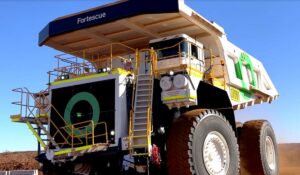
“That caution is rational: these are genuinely new drivetrains built from a standing start, on machines that have to survive some of the harshest duty cycles in industrial equipment,” Khan said.
“Fortescue went somewhere else entirely.
“XCMG isn’t a startup experimenting with electric mining trucks — it’s part of a Chinese autonomous-haulage ecosystem that has already put thousands of battery-electric and hybrid-electric mining trucks into commercial service domestically. One Chinese autonomy provider alone has more than 3000 automated trucks running across 40-plus mine sites, with battery-electric models already handling 136-tonne payloads at charging speeds up to 3.4 megawatts.
“Almost none of that shows up in Western mining press, because it’s happening in Chinese coal and iron ore operations most Western executives never visit.
“Fortescue isn’t running a science experiment. It’s importing an already-solved supply chain into a market that hasn’t fully noticed it exists yet.”
Khan says what’s “genuinely still being tested is whether that technology, and the supply relationships behind it, transplant cleanly into the Pilbara’s specific conditions, workforce and safety culture”.
“That’s a real, legitimate question.
“It’s a different question from whether battery-electric haulage is mature and conflating the two is what makes caution look like courage’s opposite instead of what it actually is: a bet on a different, slower-moving supply chain.
“Strategic conviction, in other words, isn’t really about nerve. It’s about which technology base an organisation chooses to depend on and whether it did the work to find out how mature that base already is somewhere else, before calling it unready.”
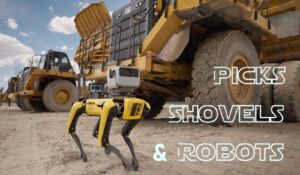
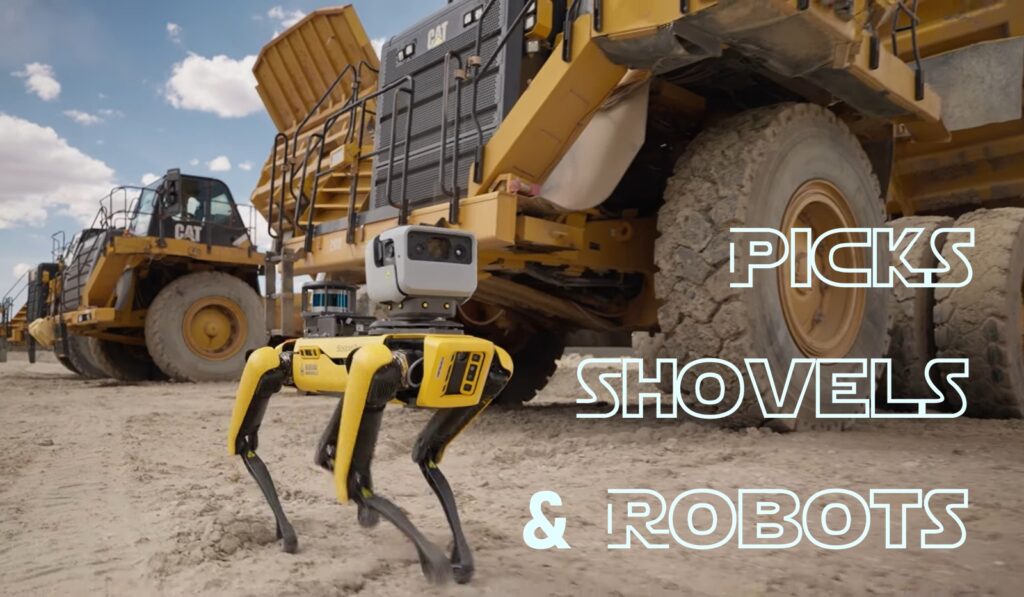
About Picks, Shovels & Robots: “When everybody is digging for gold it’s good to be in the pick and shovel business”. In the 1800s thousands rushed to California – and other parts of the world – to find gold. Most miners went broke or didn’t survive. Merchants who sold shovels, pans, denim pants and staples made a fortune. Some of the technology has changed but suppliers of essential prospecting and mining tools and services have never been more in vogue.