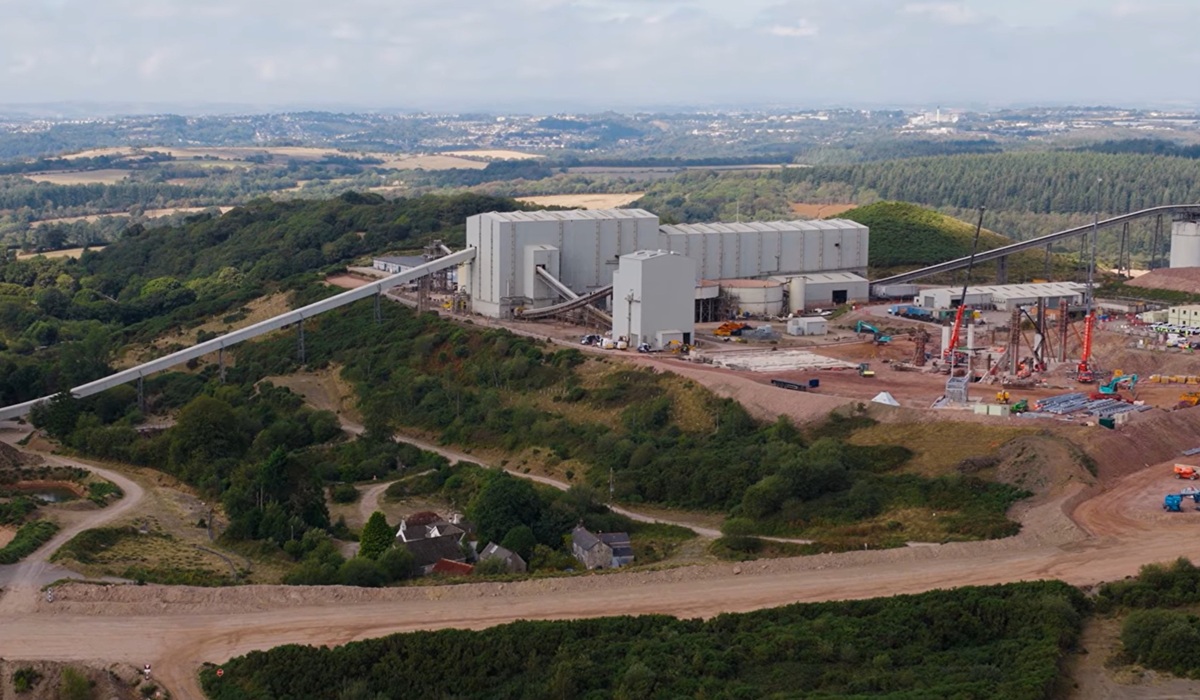
Owner of the Hemerdon tungsten mine in Devon, England, Tungsten West says a lot was learned from previous operator Wolf Minerals’ failed processing plant design and the next 12 months should show whether or not it has come up with the right answers. They include advanced ore sorting technology.
The company, which secured circa-US$95 million of UK public funding to support this month’s $93 million restart of Hemerdon, said in its 2025 project feasibility study Wolf’s three years of operation plus a “considerable amount” of metallurgical testwork and studies had “significantly improved” understanding of the beneficiation of Hemerdon ores.
The FS, compiled by AMC Consultants, said the revised process flowsheet developed for Hemerdon 2.0 “has addressed all the process issues encountered by Wolf Minerals during operations”, with preconcentration of run-of-mine ore via ore sorting and Gekko Systems In-line Pressure Jigs integral to the new plan.
“Tungsten West will be introducing an ore sorting stage into the process to reduce a large mass of barren or very weakly mineralised material from the process stream, thus substantially reducing downstream flows and therefore operating costs,” the study said.
“Multiple rounds of testwork were undertaken with equipment vendors to provide design data and variability information.”
Norwegian manufacturer Tomra says six of its X-ray transmission, or XRT, ore sorters with its OBTAIN deep learning technology formed the backbone of a new sorting house at the mine’s front end.
“The TOMRA sorters play a key role in our operating model as they select the best material for our mineral processing facility,” Tungsten West CEO Jeffrey Court said.
“By reducing the amount of material that enters the full downstream processing circuit they help lower our processing costs and environmental footprint, while allowing us to focus on the best recoverable tungsten feed.
“The material not selected for further processing also generates a high-value aggregate product for local construction activity,”
Wet screening classifies material from Hemerdon’s secondary crusher into three fractions: below 10mm, which passes directly to the pressure jigging and dense media separation circuits; 10-30mm, treated by three tertiary XRT machines; and 30-80mm, treated by three XRT 2.0 units. The six sorters operate in parallel within the new sorting house, which directs about 30% of incoming material to the concentrator for tungsten and tin recovery. The other 70% is “rejected” as an aggregate by-product sold to the construction industry.
“When you remove 70% of the rocks directly to the aggregate stream without spending energy on crushing and grinding, milling and flotation and jigging that is a huge amount of energy you do not spend,” Tomra’s industrial minerals segment manager Jens-Michael Bergmann said.
Bergmann said the company’s OBTAIN AI sorting feature introduced single-particle precision to high-throughput XRT ore sorting.
Using a neural network to identify the properties of each individual particle accurately and independently of operating capacity, OBTAIN tackled a fundamental challenge in high-throughput sorting, which was the tendency for particles to be presented in clusters that the sensor read as a single object.
“With OBTAIN we can feed each sorter with about 80% more material and have the same quality and the same recovery rates as before,” Bergmann said.
“We can simply run double the capacity.”
The capacity benefit was especially significant for tungsten ore – wolframite (as at Hemerdon) or scheelite – that typically presented as discrete inclusions in host rock. Accurate particle-level detection was critical to recovery and waste grade. Bergmann said OBTAIN’s precise, individual-particle sorting decisions, maintained even in dense, high-speed feed streams, minimised tungsten loss to the waste stream.
“The technology package we are installing represents a strong step-change for the project and will help ensure that we are a better and more resilient producer of tungsten over the long term,” said Tungsten West’s Court.
The company aims to ramp up Hemerdon to full production rates in the first quarter next year.
It is expected to produce about 3300 tonnes of tungsten trioxide concentrate per annum over an 11-year mine life.