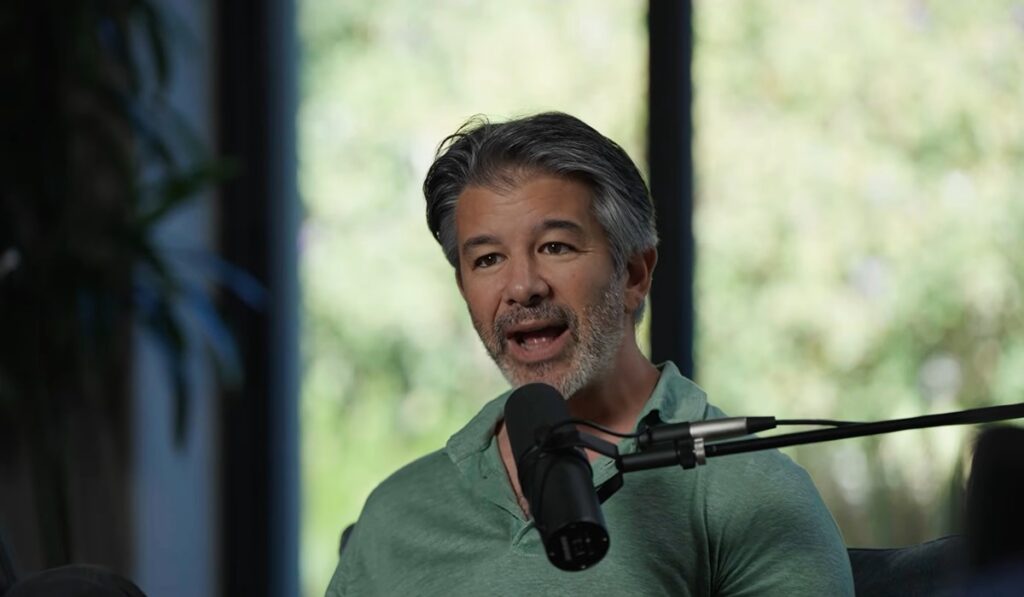
“It’s go time. We’re in the middle right now of super exponential growth on the mining side.” That’s the view Travis Kalanick has of the mining autonomy opportunity in front of his corporate vehicle, Atoms, supercharged now with US$1.7 billion of funding from Silicon Valley venture giant Andreessen Horowitz.
Or at least that’s how he’s happy to describe it.
“It’s one of the most beautiful and interesting autonomy categories or use cases,” Uber co-founder and former CEO Kalanick told Andreessen Horowitz founder Ben Horowitz and partner Erik Torenberg on a podcast after the $100 billion a16z poured $1.7 billion into Atoms.
“We can go to a gold mine CEO right now and say, would you like to get 20% more gold per year? We don’t get no.
“He [CEO] says, prove it. And we’re like, let’s go. But that’s what’s happening.”
The “top-co level” funding of Atoms means nearly $2 billion has gone into mining autonomy firms this month after the Hong Kong IPO and $293 million raise by China’s EACON at the start of July.
Atoms acquired Kalanick-backed Pronto, which built an offroad heavy industry autonomy tech stack and market presence over eight years, three months ago. Pronto has been stewarded by former Uber and Google engineer Anthony Levandowski, who was sentenced to 18 months in a US prison in 2020 for intellectual property theft from Google.
Kalanick said this week Levandowski “was one of my top leads on autonomy at Uber”. Both exited the company under a cloud.
Pronto and Japan’s Komatsu, the world’s largest mining equipment supplier, last year announced a “strategic collaboration” targeting North American quarries. Pronto also acquired Silicon Valley-based SafeAI – a start-up that did get knocked-back by a gold mine in Western Australia – last year.
Kalanick said Atoms, through Pronto, was “operating in a bunch of mines around the world”. He maintained, though, that the technology was “just now coming past human productivity”.
“So it’s like any enterprise software company. You do some cool pilots with big companies. You’ve got like eight seats at this 10,000-person company. And then all of a sudden, it’s better. In the autonomy world it’s about [being] better than human productivity.
“That’s when you hit the gas.”
Kalanick claimed mining prospects were urging Atoms to move faster. Now the company has no excuses to hold back.
“We have to do supply chain and manufacture kits,” he said.
“We have to install these kits on machines that are in the middle of the Amazon or on the border of Saudi and Iraq or in these crazy wild places, and do it fast, and then do the change management at every one of these mines.
“So they’re pushing us.
“We were a lean start-up and we’re going to muscular … Lean muscle. But we need some protein shakes, you know, and creatine and things like that.”
Atoms has food and transport arms complementing its mining division. Kalanick wrote this week: “Software has automated tasks of language and math but the complete automation of the physical world – autonomy – remains largely untouched territory, the principal unlock to the next era of progress and abundance. History refers to this kind of moment of radical progress as a Golden Age.
“Everything in our world, in our cities, in our civilisation – look around you – is mined or grown – manufactured and moved.
“The next Golden Age will be upon us when the means of growing, mining, manufacturing and moving physical things becomes fully divorced from human labour.”
A CEO of another US mining tech start-up said this week the massive Atoms equity raise was “good news for the whole industry”.
“Autonomy makes tonnes cheaper to move,” said Endolith founder and CEO, Liz Dennett.
“Cheaper tonnes lower the cut-off grade. A lower cut-off means ore that wasn’t worth mining yesterday is worth mining today. The recoverable resource base expands for everyone.
“That expansion raises the value of every technology working the rest of the stack: processing, recovery, water management [and] tailings.”
Endolith is using engineered microbes and AI-driven analytics to recover “the fraction of metal you actually capture from the rock you move”.
“The cheaper and larger the tonnage, the more that fraction decides the economics,” Dennett said.
“The front end of the mine is getting automated.
“The back end is where the next decade of value gets built and it’s great to see both get the capital they deserve.”